
Briefing Note: Assets of Community Value (ACVs) - What They Are, What They Are Not and How to Respond

This members' briefing note explains:
what an Asset of Community Value (ACV) is
what the legislation was intended to achieve
why recent large-scale moorland nominations have failed
and how members should respond if land they own or manage is nominated
A recent ACV determination has demonstrated that the current law provides strong protection for working moorland when properly understood and applied.
Download this Briefing Note (PDF) or continue reading below.
1. What is an Asset of Community Value (ACV)?
An Asset of Community Value is a designation created under the Localism Act 2011. Its purpose is to give local communities a limited opportunity to bid for land or buildings they currently use, should the owner decide to sell.
If land is successfully listed:
it is entered on the local authority's ACV register
the owner must notify the council if they intend to sell
a short moratorium period may apply before sale
Importantly:
ACV status does not prevent sale
does not force a sale to the community
and does not restrict lawful land management
2. What were ACVs originally intended for?
They were designed to protect specific community facilities, such as:
village pubs
village halls
community centres
sports grounds
libraries or local meeting places
In all these cases:
the land or building has a clear, identifiable function,
it is used regularly and locally,
and that use would be lost if the asset were sold
ACVs were not designed to:
regulate land management
recognise environmental value
protect landscapes
or act as a tool for land reform or access campaigning
3. What legal test must be met for ACV listing?
To be listed, land must satisfy all elements of the statutory test. The key requirement is that there must be:
An actual current use of the land that is not ancillary and which furthers the social wellbeing or social interests of the local community.
This means:
Actual: happening now, not planned or aspirational ideas about the future; Current not historic or occasional
Non-ancillary: not secondary or incidental to another main use (such as farming or grouse moor management)
Local community use: not general tourism or wider national interest
If any of these elements is not met, the nomination must fail.
4. Why have large moorland ACV nominations failed?
Recent decisions confirm several important principles relevant to moorland:
(a) Access rights do not equal qualifying 'use'
Much of our uplands are already subject to access rights under the Countryside and Rights of Way Act 2000. Exercising a statutory right of access (walking, recreation) does not mean the land's primary purpose is recreation. Councils have accepted that where access already exists by law, there is no need for ACV protection.
(b) Recreation must be the main land use
Walking or enjoyment of scenery is often treated as ancillary to:
farming
sporting management
conservation management
or other productive uses
Popularity alone does not make recreation the dominant use.
(c) Scale matters
ACVs apply to the whole nominated area. It is extremely difficult for any applicant to show 'actual current non-ancillary use' across thousands of acres of working land.
(d) Future intentions are irrelevant
Statements about future access, restoration, or changes in land management are legally irrelevant. ACVs protect existing use, not proposed use.
5. Why does this matter to moorland owners and managers?
Some recent ACV nominations have been promoted as part of:
campaigns to change land management
opposition to lawful sporting activity
or broader land reform objectives
Recent decisions confirm that:
ACVs cannot lawfully be used for these purposes
councils are entitled to apply the test conservatively
and working moorland has strong legal protection where evidence is properly presented
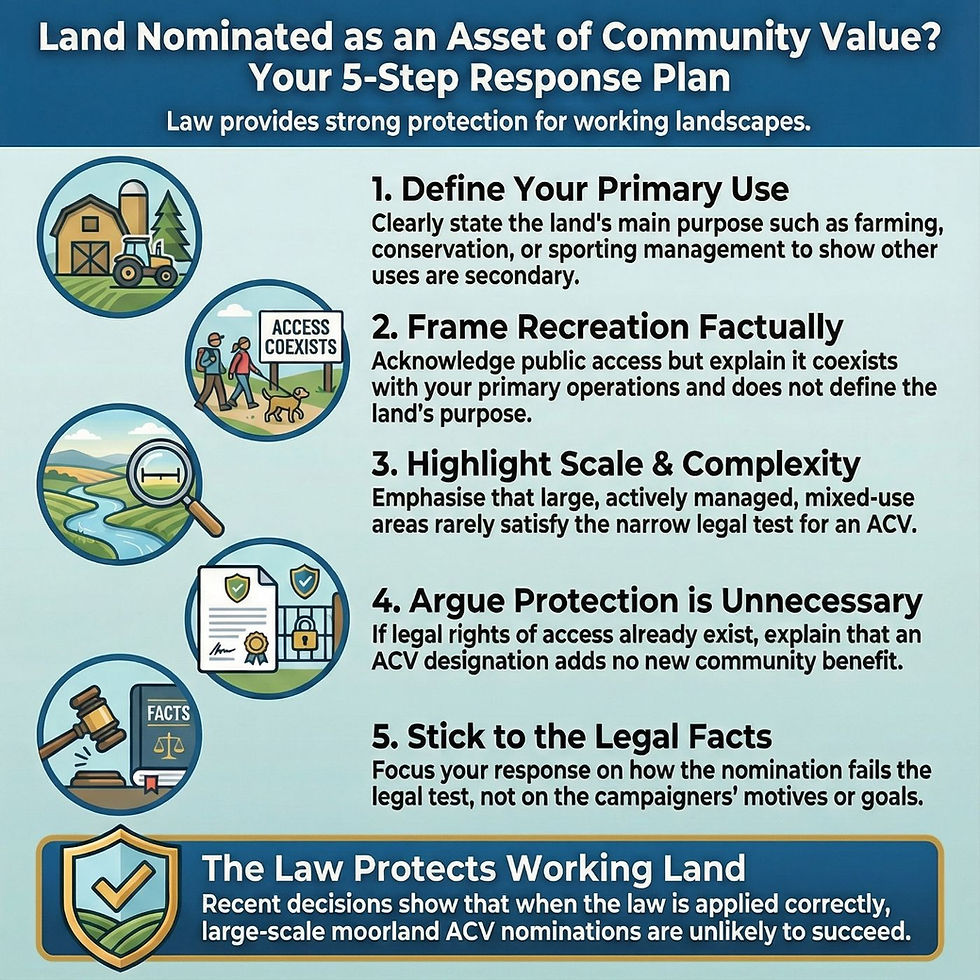
6. What members should do if they receive an ACV nomination
If land you own or manage is nominated:
Step 1: Do not ignore it
You will be consulted by the local authority. Early, factual engagement is important.
Step 2: Emphasise the primary land use
Make clear:
what the land is managed for
what activities require active management
what employment, investment, or operations take place. This helps demonstrate that other uses are ancillary, not dominant
Step 3: Address recreation calmly and factually
Acknowledge lawful access where it exists. Explain that access:
coexists with land management
does not define the land's purpose
is incidental rather than organising
Avoid emotive language.
Step 4: Highlight scale and mixed use
Make clear where land is:
fenced
actively managed
subject to operational constraints
Large, mixed-use areas are rarely capable of satisfying the ACV test.
Step 5: Point out where ACV protection is unnecessary
If access already exists in law, explain that ACV designation adds nothing. Councils are entitled to consider whether ACV status would be redundant.
Step 6: Avoid speculation about motives
Focus on the legal test, not the nominator's campaign objectives. Let the authority draw its own conclusions.
7. Key points for MA members
The current ACV framework:
is narrow in scope
strongly focused on existing, place-based community use
and not suited to working landscapes.
Recent determinations show that when councils apply the law correctly, large-scale moorland ACV nominations are unlikely to succeed. Members should take reassurance from this and respond confidently, factually and proportionately.
Stay Updated
📧 Keep updated on all moorland issues - sign up for our FREE weekly newsletter.


