
Burning Report: How Rigorous Was Peer Review?

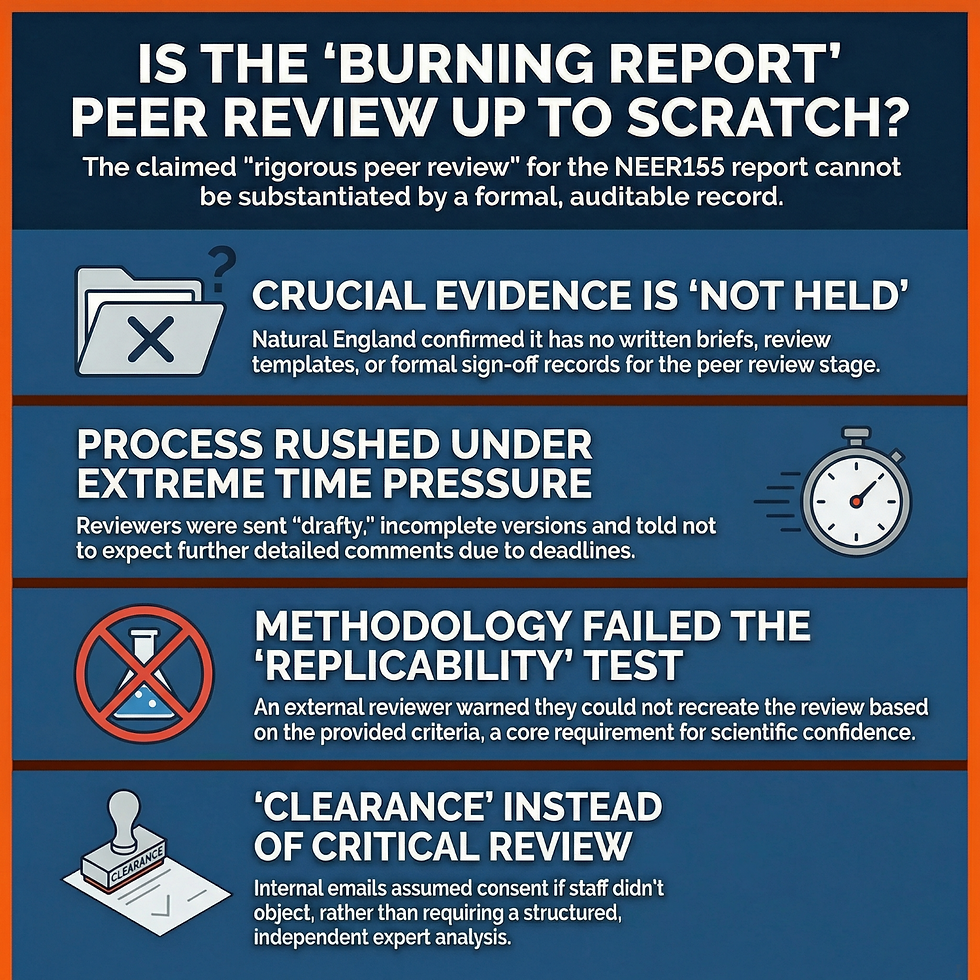
✅ KEY TAKEAWAY: Natural England cannot prove its influential managed burning report underwent the "rigorous peer review" claimed by Ministers. We are formally demanding full transparency and accountability from NE and Defra.
Last year Natural England published an “evidence review” on managed burning (NEER155) - a report that is now being relied upon in policy and regulatory discussions affecting burning, stewardship conditions and upland land management.
This report is formally titled “NEER155 - An evidence review update on the effects of managed burning on upland peatland biodiversity, carbon and water”.
Ministers have since told Parliament that this burning evidence review went through "rigorous peer review" prior to publication.
We are not disputing that external experts provided comments (the report says it was externally reviewed and names the individuals).
Our question is narrower - and important:
What documented process underpins the assurance of “rigorous peer review”, and does it match what Parliament and the public would reasonably understand by that term?
To keep members fully informed, we are publishing our letter to Natural England and Defra and the supporting annexes alongside this update.
1) What we mean by “rigorous peer review”
In our letter, we set out what “rigorous peer review” should mean in this context: a process with (i) defined scope/instructions, (ii) reviewer access to the complete draft (or a clearly documented subset), (iii) a documented way of recording/responding to comments, and (iv) a recorded completion/sign-off of the external review stage.
We also make clear this is not about whether any external comments were received - it is about whether the public assurance denotes a structured, auditable assurance stage that can be substantiated on the retained record.
2) What Natural England has confirmed is “not held”
Following disclosure under a freedom of information request, Natural England has confirmed that key artefacts normally expected to evidence a “rigorous peer review” process are not held, including:
No written brief / terms of reference / structured guidance for reviewers.
No review templates / scoring frameworks / checklists.
No document defining what materials were subject to peer review (full draft vs subset), and NE also state that individual study quality assessment forms were not sent to reviewers.
No formal record confirming completion and sign-off of the peer review stage is held.
This goes to the heart of the issue: if “rigorous peer review” is being used as an assurance in Parliament and policy, the process should be capable of being evidenced by a retained audit trail.
3) Evidence the process was compressed, and drafts were still evolving
The disclosed emails show explicit time pressure, with reviewers told:
“Due to time pressure to publish the report…” and “we are not expecting further detailed comments at this stage.”
A “relatively near complete but not yet edited… ‘drafty’ version”, with sections still needing completing, and a request for comments “by the middle of next week”.
The internal cross-cutting circulation email also frames the exercise in a way that looks more like clearance than structured peer review:
recipients were told to forward it “to anyone who might have an interest”, and that “a nil response will be taken as an assumption that you do not object to the report being published.”
Time pressure doesn’t prove bias - but it does increase governance risk, particularly for a contentious evidence review now being relied upon in regulatory settings.
4) A reviewer flagged replicability risk
One external reviewer wrote that they wanted “greater description of the inclusion and exclusion criteria” because:
“I didn’t get a feel that I could recreate this review based on that section.”
That is a methodological transparency concern - and replicability is central to confidence in an “evidence review”.
5) NE’s own guidance says methodology assurance is required for Evidence Reviews
Natural England’s Technical Publications guidance states that for its evidence reviews:
“the methodology itself also needs to be reviewed… to ensure it meets evidence review standards”, and confirmation should be included in the Publication Submission Form.
In the disclosed Publication Submission Form for NEER155, the level of review is recorded as Tier 4, and the form shows the question about methodology review - but also records the submission date as 06/12/2024 and that it was later “edited 18/02/2025”.
That is why our letter asks what changed on 18/02/2025, by whom, and whether this altered the assurance record.
6) A further governance issue: “review” vs “editing/proof-reading”
Natural England’s response to us says: “A final, additional external reviewer provided comments, edited and proof-read the final draft report.”
That may be perfectly legitimate - but it is not the same as independent peer review. Our letter therefore asks for clarity on who commissioned this, whether it was contracted/paid, what role the individual was asked to perform, and how this was represented when the term “rigorous peer review” was used publicly.
Why members and the public should care
This is not an academic debate about wording. NEER155 is being used to inform:
stewardship and regulatory approaches, and
enforcement contexts affecting upland land management.
If “rigorous peer review” is used as a shield in Parliament and policy, it needs to be capable of being substantiated by a clear, documented process - not merely asserted.
What the Moorland Association has now done
We have written jointly to Natural England and Defra seeking formal clarification, and asking for specific documents/confirmations within 20 working days - including: what versions were reviewed, what reviewers were asked to do, how comments were recorded and addressed, how completion/sign-off was evidenced, and the documentary basis for ministerial assurances.
Transparency
To keep members fully informed, we are publishing:
We will update members when responses are received.
This blog is intended to inform Moorland Association members and the wider public. It does not seek to anticipate or comment on any ongoing legal proceedings.
Stay Updated
📧 Keep updated on all moorland issues - sign up for our FREE weekly newsletter.


