
How "Burn-to-Rewet" Cuts Methane Emissions by 95%

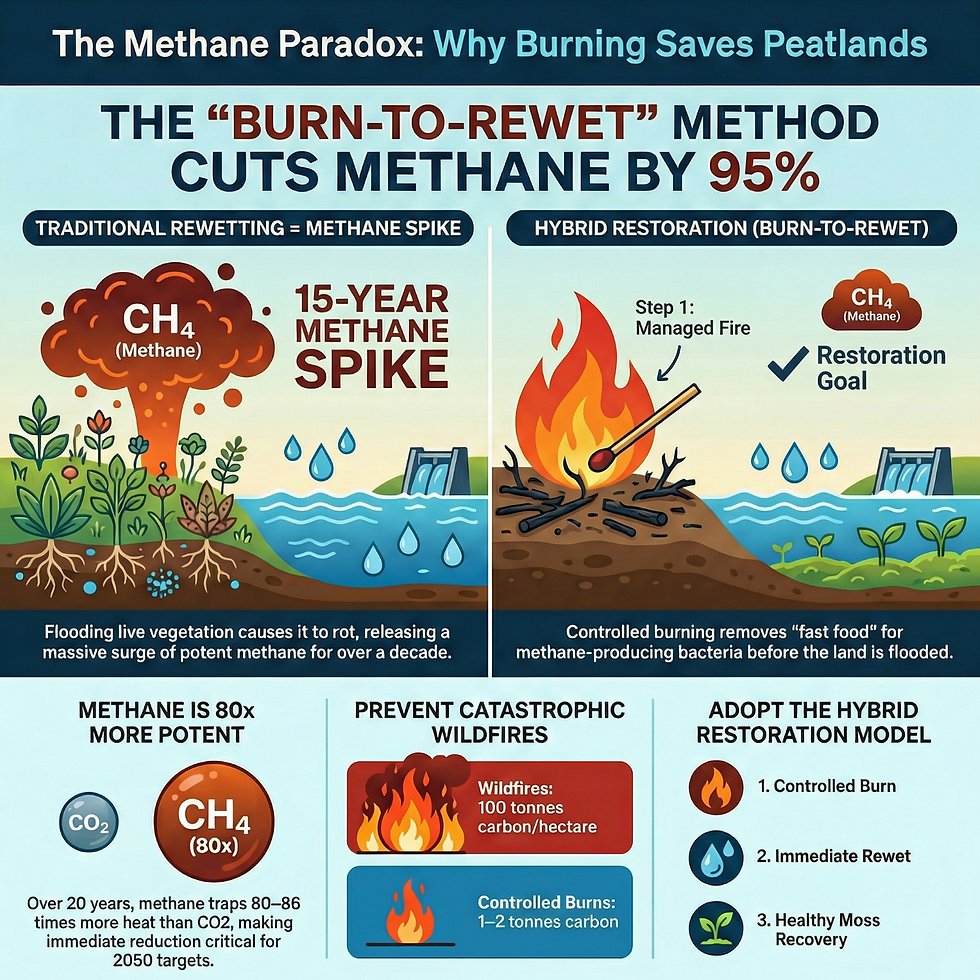
✅ Key Takeaway: A "burn-to-rewet" restoration approach cuts methane emissions by 95% compared to rewetting alone, making controlled burning essential for immediate climate safety and genuine Net Zero progress.
If you follow the conversation around Net Zero, you know the standard narrative: Peatlands are our rainforests. Rewetting them is the silver bullet for climate change. Burning is bad.
It sounds simple. Ideally, it would be simple. But as land managers, we know that nature rarely fits into neat boxes.
Research suggests that our current "hands-off" approach might actually be damaging the climate in the short term. The findings are uncomfortable for some, but they are crucial for anyone who cares about genuinely hitting our carbon targets.
Here are the 5 most surprising findings from the data - and why we need a "Hybrid Restoration" approach.
1. The "Methane Spike" Is Massive (and Long)
We are often told that rewetting a bog stops carbon dioxide (CO2) from escaping. That is true. But it ignores a "Methane Paradox" that is often brushed under the carpet.
When you flood a drained bog that is covered in heather and grasses, that vegetation dies and begins to rot underwater without oxygen. This rotting process doesn't release CO2; instead, it triggers a massive surge in methane - a greenhouse gas that is far more potent.
This isn't just a brief "burp." This "methane spike" can last for 15 years or more. For over a decade, a restored bog can actually be worse for the climate than a drained one before it finally stabilizes.
2. Burning Can Actually Reduce Emissions
This is the finding that will surprise most people. A groundbreaking 2025 study (Cui et al.) tested what happens if you burn the vegetation before you rewet the land, rather than just flooding it.
The results were staggering.
The "burn-to-rewet" method reduced methane emissions by over 95%.
How? Think of fresh vegetation (leaves, stalks, litter) as "fast food" for methane-producing bacteria. If you flood that vegetation, the bacteria feast on it and pump out methane. But if you burn it first, you remove that "fast food" and turn some of it into charcoal (which stores carbon for centuries). The bacteria starve, and the methane spike never happens.
Far from being a climate villain, a controlled burn could be the most effective tool we have to make restoration "climate safe" from day one.
3. The "20-Year Trap"
Climate policies often look at impacts over 100 years (GWP100). Over a century, rewetting looks great because the CO2 savings eventually outweigh the methane.
But we don't have 100 years to fix the climate crisis. We need to act now.
Over a 20-year period (GWP20), methane is 80–86 times more powerful than CO2. This means that if we blindly rewet huge areas without managing the methane spike, we could be "front-loading" global warming right when we can least afford it. Current policies might be helping us hit 2125 targets while causing us to miss our 2030 and 2050 targets.
4. Why Cutting Isn't a "Silver Bullet"
In recent years, many managers have been pressured to stop burning and start mechanical cutting (mowing) instead. It feels like a safer, softer option. But the science suggests it has a hidden cost.
When you mow heather, you leave behind a thick mat of shredded vegetation, known as "brash."
The Methane Problem: This rotting brash acts as a super-fuel for methane bacteria when the site is rewetted - potentially making the methane spike even worse than leaving the plants standing.
The Fire Risk: Dry brash acts like kindling. The James Hutton Institute trials found that this layer of fine fuel significantly increases the risk of accidental ignition compared to a clean, burned surface.
5. The Firefighting Trap
Finally, the research identifies a dangerous feedback loop called the "Firefighting Trap."
By banning controlled burns in the name of safety, we inadvertently allow fuel loads (vegetation) to build up to dangerous levels. We might stop small, controlled fires, but we increase the risk of uncontrollable "mega-fires" that burn deep into the peat soil.
The carbon cost of a wildfire is catastrophic - releasing up to 100 tonnes of carbon per hectare, compared to just 1–2 tonnes for a controlled burn. The research suggests that "prevention" (banning burns) is actually causing the very disaster it claims to avoid.
It’s Time for Hybrid Restoration
The science is clear: the binary choice between "Burning vs. Rewetting" is false. We need both.
The research suggests a Hybrid Restoration model may be most effective:
Burn: Use a single, controlled fire to strip away the "fast food" vegetation.
Rewet: Immediately block the drains to raise the water table.
Restore: Let the mosses recover without the massive methane debt.
To save our peatlands, we need to follow the flux data, not the dogma. It is time for policy to catch up with the science so we can deliver genuine Net Zero results.
Stay Updated
📧 Keep updated on all moorland issues - sign up for our FREE weekly newsletter.


