
New Poll Reveals Crisis of Trust in BBC Rural Coverage

Updated: Dec 12, 2025
A national broadcaster holds a unique and vital position in public life. The BBC, funded by a universal license fee, has a fundamental duty to reflect, represent, and serve the entire nation in all its diversity. It is against this core mission that new evidence reveals a profound and damaging disconnect between the Corporation and Britain's rural communities.
The recent resignation of the BBC’s top leadership over the misleading editing of a Donald Trump speech has laid bare a systemic problem with editorial bias. The crisis of trust this exposed is not confined to politics; it is a problem that rural Britain has been forced to endure for over a decade.
Devastating new polling from YouGov establishes beyond doubt that rural Britain has lost faith in the broadcaster. This is not a sudden development but the culmination of long-standing concerns over biased, inaccurate, and metropolitan-centric coverage that misrepresents the lives and livelihoods of millions. The data paints a picture of a relationship at a breaking point.
In response, the Regional Moorland Groups have written directly to the incoming Director General of the BBC. The letter is not simply a complaint; it is a demand for urgent and meaningful reform to address a decade of neglect and restore impartiality to the Corporation's rural coverage. The evidence that follows makes this action not just necessary, but essential.
A Crisis of Trust: The Numbers
For years, anecdotal evidence has pointed to a deep-seated bias in the BBC’s portrayal of the countryside. Now, new quantitative data from YouGov provides undeniable proof of a systemic problem.
These figures are not matters of opinion but hard facts that make the issue of trust impossible for the BBC to ignore. The polling reveals a gulf between the broadcaster and its rural audience:
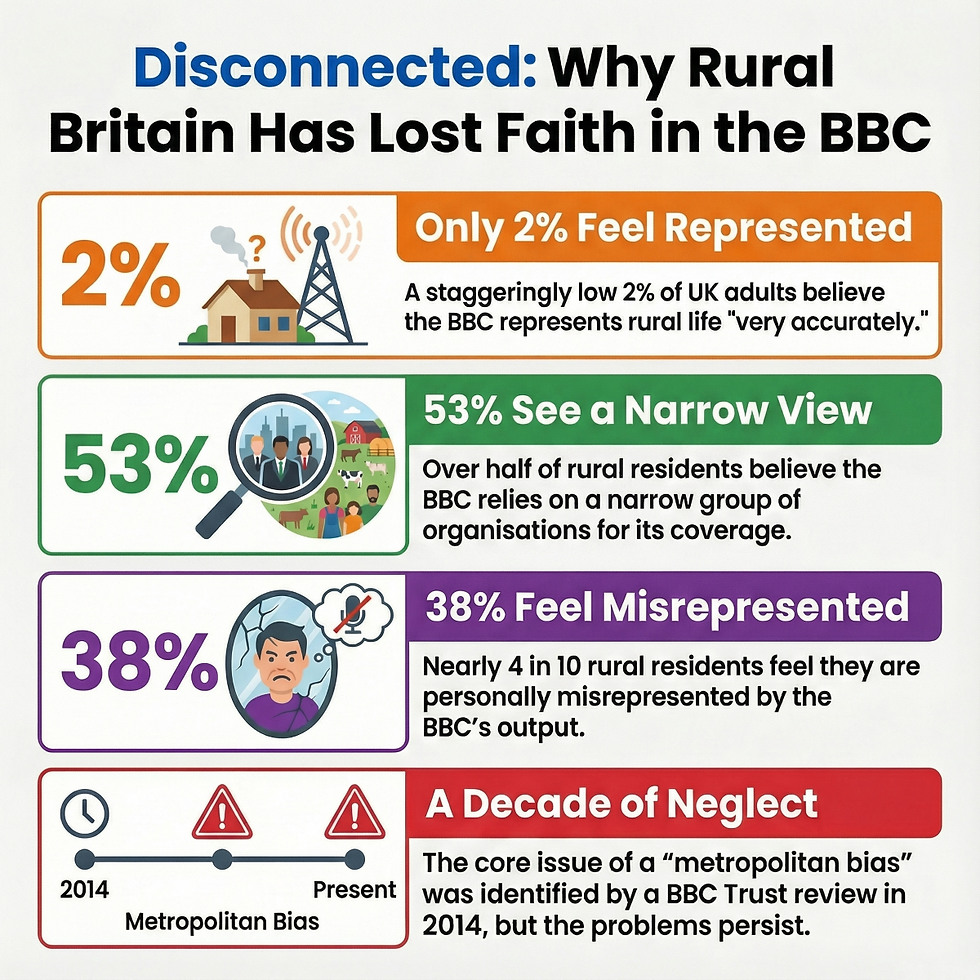
A staggeringly low 2% of all UK adults believe the BBC represents rural areas "very accurately," a figure that should alarm anyone concerned with the health of public service broadcasting.
More than half of those living in the countryside - 53% of people in rural Britain - believe the BBC relies on a "narrow group of individuals and organisations" for its coverage, echoing concerns first raised in a 2014 BBC Trust review.
The impact is deeply personal, with 38% of rural residents stating that they feel they are personally misrepresented by the Corporation’s output.
These statistics are more than just numbers; they are a verdict on the BBC's performance, delivered by the very communities it is meant to serve, and they expose an institutional blind spot that has allowed a damaging and inaccurate narrative to take hold.
The Root of the Problem: A Decade of Neglect
The polling results are not an anomaly but a direct consequence of a persistent and identifiable editorial culture within the BBC. This crisis has been a decade in the making, stemming from unresolved issues that the Corporation itself identified and then failed to address.
The core issue of a "metropolitan bias" is not a new accusation. It was officially acknowledged by the BBC's own Trust Impartiality Review back in 2014. That landmark report found that rural stories were too often viewed through an "environmentalist" lens, overlooking the economic, social, and practical realities of life and work in the countryside.
The review warned of a serious imbalance, yet ten years on, the same problems persist.
A key driver of this bias is the BBC's over-reliance on a narrow set of sources. The Corporation consistently gives disproportionate airtime to urban-based campaigning organisations and NGOs, such as the RSPB, allowing them to set the agenda for rural affairs.
In stark contrast, the voices of those who live and work on the land - the gamekeepers, farmers, land managers, and rural workers whose families have shaped these landscapes for generations - are marginalised or absent entirely.
This editorial framing is reinforced by the commentary of regular BBC presenters.
Chris Packham, a leader of the anti-field sports campaign group Wild Justice and vice president of the RSPB, remains a face of BBC nature programming. He has publicly referred to farmers and gamekeepers as "the nasty brigade."
Mark Carwadine, another BBC regular, has described grouse shooting as involving "wildlife slaughter and habitat desecration on an industrial scale."
These are not the words of impartial observers but of active campaigners. Crucially, neither has been properly reprimanded by the BBC, and the contrasting viewpoint has never received this level of support on BBC programming. This demonstrates an institutional failure to enforce the BBC's own standards of impartiality.
Do You Trust BBC Rural Coverage?
Yes
No
Demands for Meaningful Reform
Criticism without a constructive path forward achieves little. The demands outlined in the Regional Moorland Group's letter to the incoming Director General are not arbitrary; they are targeted, specific solutions designed to address the deep-rooted problems of metropolitan bias, source over-reliance, and the pervasive "environmentalist lens" detailed above.
Appoint genuinely independent rural correspondents with direct, practical experience of farming and land management, rather than tasking environmental analysts with covering rural affairs as an afterthought.
Create a dedicated Rural Affairs department with genuine autonomy, ensuring rural issues are treated with the seriousness they deserve and not continually subsumed within environmental programming.
Establish clear editorial guidelines that limit the prominence given to campaigning NGOs and require demonstrable balance with the voices of rural workers, farmers, and land managers.
Ensure proper weight is given to the economic, social, and ecological perspectives of those who work the land in coverage of all contentious rural issues.
Train editorial staff to understand the critical difference between environmentalism as an ideological position and the practical realities of land management and food production.
Implementing these reforms would signal a genuine commitment to serving the entire nation and would be a critical step toward fulfilling the BBC’s fundamental public duty.
Conclusion: A Duty to the Entire Nation
The evidence is clear. The polling data, the decade of institutional neglect since the 2014 Trust Review, and the consistent examples of presenter bias prove that the BBC is failing in its public service remit to the British countryside. An organisation funded by everyone must serve everyone, yet rural communities feel unrepresented, misrepresented, and ignored.
For the BBC to justify its license fee and maintain its credibility as a national institution, it cannot continue on its current path. The question must be asked: if the BBC cannot serve rural Britain fairly, why should rural Britain continue to fund the BBC? This is not a rhetorical question but an existential threat to the Corporation’s funding model.
The BBC must urgently reform its approach, embed genuine impartiality in its editorial culture, and demonstrate that it can serve all parts of the United Kingdom "without fear or favour." The crisis is real, but so is the opportunity for change. Rural Britain is watching.
Stay Updated
📧 Keep updated on all moorland issues - sign up for our FREE weekly newsletter.


