
Rewetting: Why Summer Water Levels Are Critical for Peatland Carbon
- Rob Beeson

- Jan 21
- 3 min read
Updated: Jan 22
For decades, moorland managers have been at the forefront of peatland restoration. We know that healthy, wet peat is vital - not just for the grouse, waders, and unique flora that call our moors home, but for the carbon stored beneath our feet.
Recently, the conversation has often been simplified to a single directive: "rewet the moors." While the sentiment is correct, experienced land managers know that the reality of hydrology is never that simple.
A compelling new scientific study backs up this practical knowledge. It suggests that simply raising water levels isn't enough; it is when the water is there that counts.
The Research
The study, published in the journal Biogeosciences by researchers from the Geological Survey of Denmark and Greenland and the University of Copenhagen, took a detailed look at how peatlands breathe.
Instead of looking at yearly averages - which can hide important details - they used advanced computer models to simulate daily changes in water levels and temperature over decades. They looked at a drained peatland catchment (very similar to many of our own degraded sites) to see how different management strategies would affect carbon dioxide (CO2) emissions in a changing climate.
The Findings: Summer is King
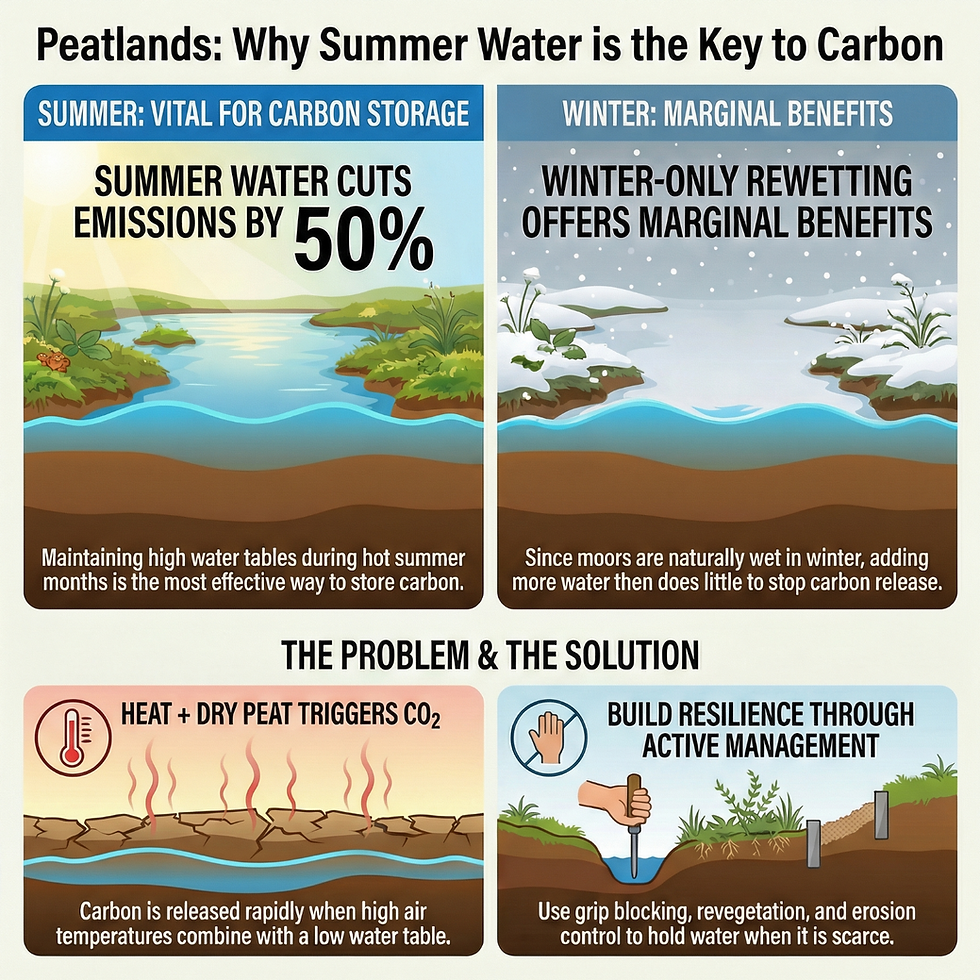
The most significant finding for us in the uplands is clear: Summer water levels matter most.
The researchers found that CO2 emissions are driven by "compound events" - a scientific term for when two bad things happen at once. In this case, high air temperatures combined with a low water table.
When the sun is beating down in July and August, and the peat dries out, the carbon stored in the soil is released rapidly.
Conversely, the study showed that rewetting strategies focusing only on raising water levels in winter had "marginal" benefits. Since our moors are often naturally wet or frozen in winter anyway, adding more water then does little to stop carbon release.
Key Statistics
The difference between getting it right and getting it wrong is stark:
Marginal Reductions: Strategies that primarily increased winter water levels resulted in very little reduction in annual CO2 emissions.
50% Reduction: Strategies that successfully maintained high water tables during the warm summer months could reduce CO2 emissions by up to 50%.
Practical Implications for Moorland Management
This research validates the approach of "active management" over passive abandonment.
Simply blocking a drain and walking away might make a site wetter in winter, but if that water isn't retained effectively through the dry spells of summer, the conservation benefit is lost.
To achieve that 50% reduction, we need resilient landscapes that hold onto water when it is scarce. This supports the traditional techniques many members are already employing:
Strategic Grip Blocking: Slowing the flow to keep water on the hill for longer.
Revegetation: Encouraging Sphagnum moss and other vegetation that acts as a sponge, regulating the water table naturally.
Erosion Control: Fixing hags and gullies to prevent the water table from dropping locally.
Looking Ahead
The study also warns that climate change will make this harder. As summers get hotter, the "temperature sensitivity" of peat means it will release CO2 faster if it dries out.
However, the authors noted that if we can manage the water table correctly - keeping it high during those critical hot windows - we can "counterbalance" the effects of rising temperatures.
This reinforces the role of the land manager. We are not just preserving a view; we are actively managing a complex hydrological system. By focusing our efforts on summer resilience, we protect the carbon store, support our wading bird populations (which need wet ground for feeding chicks), and maintain the overall health of the moor.
Science is catching up with what many in the rural community have long practiced: effective conservation requires detail, observation, and year-round stewardship, not just a broad-brush approach.
Stay Updated
📧 Keep updated on all moorland issues - sign up for our FREE weekly newsletter.


