
Science Confirms: Controlled Burning Protects Moorland Soils and Carbon

Updated: Sep 22
Quick summary
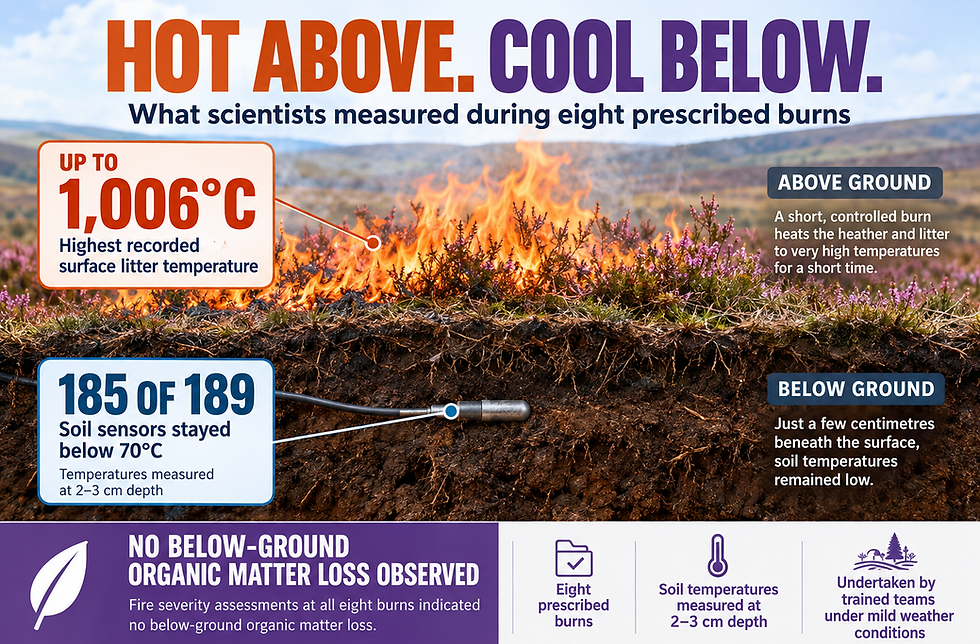
Scientists monitored eight trained prescribed burns across upland and lowland heaths in Scotland, Yorkshire and Dorset.
Surface flames hit 1000°C, but soil just three centimetres down averaged a maximum of 17°C.
All eight fires caused zero loss of below-ground organic matter, leaving peat carbon stores locked in.
Slope direction made no difference, and "quick, cool burns" taught by modern training worked as intended.
For centuries, the careful application of fire has been a cornerstone of moorland management. Prescribed burning is a deeply traditional skill, passed down through generations of rural communities.
It clears old, woody heather, encourages fresh green shoots for livestock and red grouse, and helps prevent devastating summer wildfires by reducing heavy fuel loads. However, in recent years, this vital land stewardship practice has faced intense scrutiny.
Much of the public debate centers on the UK’s peatlands. Peat is a massive natural carbon vault. Critics of prescribed burning worry that setting fire to surface vegetation might heat the underlying peat, causing it to smoulder and release its stored carbon into the atmosphere.
To find out exactly what happens beneath the surface during a routine burn, scientists from the University of Exeter and other institutions conducted a comprehensive field study. The resulting paper offers incredibly positive news for rural land managers and conservationists alike.
The Key Findings
The study’s results firmly support the safety and sustainability of traditional burning when conducted responsibly. Here are the most important statistics from the research:
Soils stay cool: While surface flames reached impressive temperatures of up to 1000°C, the average maximum temperature recorded just three centimetres into the soil was a remarkably low 17°C.
No underground damage: Post-fire visual assessments confirmed there was absolutely zero loss of below-ground organic matter across all eight test fires.
Carbon stores remain locked: The soil temperatures never reached the high levels required to damage peat, meaning the carbon safely remained in the ground.
Modern training works: The "quick, cool burns" advocated by land management training programs successfully remove surface fuel without harming the earth below.
Putting the Science to the Test
The research team wanted to observe real-world conditions, not just laboratory simulations. They partnered with four different land management teams across the UK. Crucially, these teams were fully trained to modern standards, such as the widely recognized Vegetation Fire Operator course.
The scientists monitored eight separate prescribed burns. These took place on both upland and lowland heaths, covering sites from the Cawdor Estate in Scotland to Spaunton Moor in North Yorkshire, down to Corfe Common in Dorset. These locations included a mix of standard mineral soils and the highly debated organic-rich peaty soils.
Before the gamekeepers and land managers lit the fires, the researchers placed a vast network of specialized temperature sensors across the landscape. They measured the heat at the surface, high in the vegetation canopy, and buried directly in the soil beneath the heather.
Heat Rises, Soils Survive
The data collected during these burns paints a fascinating picture of fire behaviour.
Above ground, the fires did exactly what they were supposed to do. They burned hot and fast. Temperatures in the surface litter and vegetation frequently peaked between 700°C and 1000°C. This rapid heat effectively cleared the targeted scrub and woody growth.
But below ground, the story was completely different. The damp earth acts as a powerful natural insulator. The study found that heat simply did not penetrate the surface.
Across all the sites, the soil temperatures almost never exceeded 70°C. In fact, out of 189 underground sensors, only four registered a temperature above 70°C, and only for a matter of seconds.
To put this incredible insulation into perspective, the researchers noted a remarkable event at one Scottish site. Patches of snow that were on the ground before the burn were still sitting there after the fire had passed directly over them. The surface heating was so brief that it could not even melt the snow, let alone ignite the wet peat hidden beneath.
Weather and Slopes: The Mechanics of a Safe Burn
The study also highlighted the importance of the careful planning that goes into every prescribed burn.
The fires monitored were conducted during the legal burning season, specifically taking advantage of mild weather windows in February and March. The trained teams operated under strict safety conditions. Wind speeds were consistently low, and the air temperature before the burns was always below 10°C.
Interestingly, the researchers also looked at how the slope of the land affected soil temperatures. The study tested fires burning upslope, downslope, and across the slope.
Regardless of the fire's direction, the soil temperatures remained incredibly low. The average maximum soil temperature for an upslope burn was just 17°C, which was almost identical to burns moving downwards or sideways.
This proves that the fundamental nature of a well-timed burn is highly resilient. As long as the basic safety and weather parameters are respected, the angle of the hill does not put the soil at risk.
Validating Rural Expertise
For those who live and work on the moors, these findings are a strong validation of their expert land stewardship.
The stated goal of prescribed burning guidance is to achieve a "quick, cool burn." This means the fire moves swiftly across the landscape, consuming the canopy but leaving the moss, leaf litter, and soil perfectly intact.
The study’s fire severity scores proved this goal is being met. The scientists found no signs of deep burning. The moss layers were largely untouched, meaning vital bog-forming species remain safe to continue their growth cycle.
This research provides essential, hard data to inform the ongoing debate about moorland conservation. It demonstrates that when land managers combine their traditional, generational knowledge with modern accredited training, the results are overwhelmingly positive.
Properly managed fire is not the enemy of the peatland; it is a carefully wielded tool that protects it. Our rural communities can continue to sustain these iconic landscapes for generations to come.


