
New Global Study Reveals the Reality of Soil Heating in Wildfires and Prescribed Burns

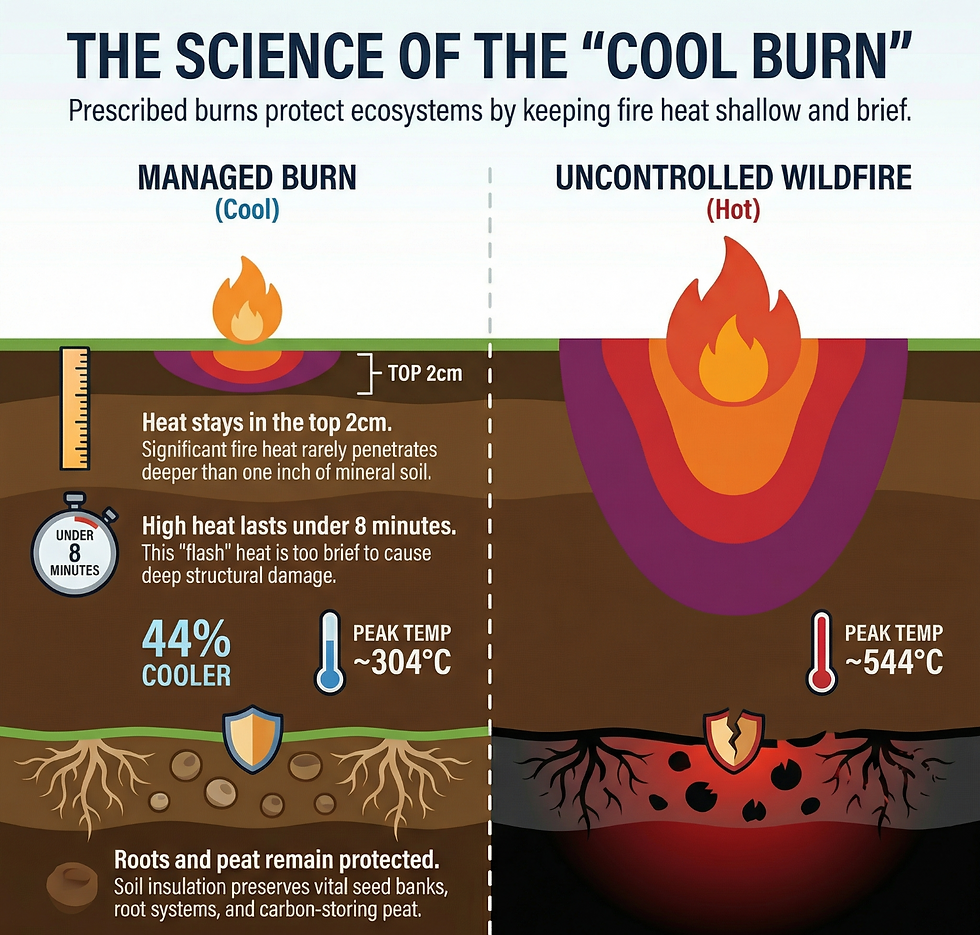
✅ KEY TAKEAWAY: Real-world data confirms that prescribed burns generate short-lived, shallow heat that leaves the deeper soil, roots, and peat layers protected, validating the safety of traditional "cool burn" management.
For generations, land managers across our uplands have utilized prescribed burning as a vital tool for conservation and wildfire mitigation. This traditional practice, often referred to as "cool burning," is designed to remove old vegetation while leaving the underlying soil and root systems intact.
However, the impact of fire on soil health has long been a subject of scientific debate. A groundbreaking new study published in the International Journal of Wildland Fire provides fresh, global evidence that validates what many on the ground have long understood: when it comes to soil, fire behaviour in the real world is vastly different from what is often seen in the laboratory.
The Study: A Global Perspective
The paper, titled "Soil heating during wildfires and prescribed burns: a global evaluation" (Doerr et al., 2025), is the first comprehensive global analysis of its kind. The researchers compiled data from 55 different fires across five continents, comparing real-world measurements from wildfires and prescribed burns against laboratory experiments.
The goal was simple but critical: to determine exactly how hot the soil gets during a fire and how deep that heat penetrates.
Key Finding: Heat Remains on the Surface
The most significant finding for our moorland communities is the limited depth of heat penetration. The study reveals that for the vast majority of fires - both wild and prescribed - significant heating is confined to the very top layer of the soil.
The data shows that heat rarely penetrates beyond the top 2 centimetres (less than an inch) of the mineral soil. Even more reassuringly, at a depth of just 1 centimetre, temperatures rarely exceeded 300°C.
This confirms that the "insulating" effect of soil is highly effective. While the vegetation on top may burn, the vital seed banks, root systems, and peat layers sitting just centimetres below remain largely protected from extreme heat.

Fast and Furious? No, Fast and Shallow
Another crucial aspect of the study is the duration of heating. In laboratory settings, researchers often "cook" soil samples for 30 minutes to an hour to simulate fire effects. This new study suggests those lab models are often inaccurate.
In real-world scenarios, the heat pulse is surprisingly short. The study found that temperatures above 300°C typically lasted for less than 500 seconds (about 8 minutes). This "flash" heat is sufficient to regenerate vegetation but is generally too brief to cause deep structural damage to the soil ecosystem.
Prescribed Burns vs. Wildfires
The research highlights a clear distinction between managed prescribed burns and uncontrolled wildfires. On average, the maximum soil surface temperature for wildfires was found to be 544°C, whereas for prescribed burns, it was significantly lower at 304°C.
This statistical difference underscores the value of prescribed burning as a controlled management tool. By burning under the right conditions - when the ground is damp and the weather is cool - land managers can achieve conservation goals with a much "cooler" fire footprint than the devastating wildfires we are working to prevent.
What This Means for Moorland Management
For those living and working on the moors, this science supports the principles of responsible land stewardship.
Protection of Peat: The study confirms that short-duration fires do not transmit high heat deeply. This suggests that a well-managed "cool burn" is unlikely to ignite or damage the underlying peat or deep organic layers, preserving our vital carbon stores.
Regeneration: Because the heat doesn't penetrate deep, the rootstock of heather and other moorland plants survives, allowing for rapid regeneration. This is essential for maintaining the mosaic of habitats that supports grouse, waders, and other wildlife.
Correcting the Narrative: The authors note that many assumptions about fire damaging soil are based on lab experiments that apply heat for too long. This paper helps correct the record, aligning scientific understanding with the practical observations of gamekeepers and farmers.
Conclusion
This global evaluation offers robust scientific backing for traditional conservation techniques. It demonstrates that fire, when managed correctly and respectfully, remains a surface-level event. It allows us to renew the land without harming the life beneath it.
As we face increasing risks from climate change and wildfire seasons, understanding the true interaction between fire and soil is more important than ever. This research confirms that prescribed burning remains a safe, effective, and scientifically sound method for protecting our rural landscapes and livelihoods.
Stay Updated
📧 Keep updated on all moorland issues - sign up for our FREE weekly newsletter.


