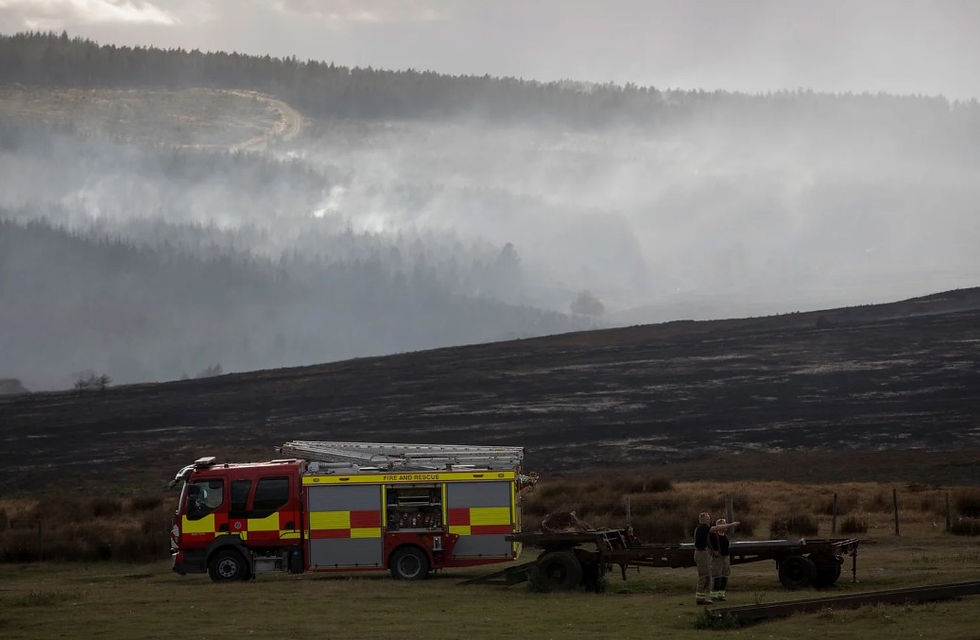
Why We Need a Rural Partnership for Wildfire Prevention and Response
- Rob Beeson

- May 11
- 3 min read

In 2025 alone, wildfires devastated 46,000 hectares of the UK landscape and cost our economy a staggering £460 million. As the Environment, Food and Rural Affairs (EFRA) Committee asks what resources and training our emergency services need to respond to this escalating crisis, the Moorland Association has a clear, evidence-based answer.
The bottom line is this: our Fire and Rescue Services (FRS) are dangerously overstretched and cannot fight this battle alone. To protect our rural landscapes, the government must formally integrate the highly skilled, unpaid workforce of local gamekeepers into the national emergency response.
Furthermore, we must fund specialist rural training for firefighters, and, crucially, we must recognise proactive land management - specifically controlled burning - as the ultimate preventative resource. We cannot simply fight our way out of this crisis; we must manage the fuel before the fire starts.
The True Cost of Inaction and Resource Deficits
To understand what resources our emergency services need, we must first look at what they have lost. Over the past fifteen years, central government funding for the fire and rescue service has been cut by 30% in cash terms. This has led to the loss of nearly 12,000 firefighters since 2010 - equating to one in five posts.
When a wildfire breaks out in a remote upland area, the resource deficit becomes painfully clear. Academic research estimates that FRS response costs for wildfires sit at around £55 million per year across the UK. A single large moorland blaze can incur up to £1 million in firefighting costs and require the deployment of dozens of fire engines over multiple days.
However, urban-focused fire engines and standard equipment are often entirely unsuited for hard-to-reach moorland terrain. Fire services lack the specific all-terrain transport and remote water-delivery systems required to tackle deep peat fires effectively.
The Gamekeeper Partnership: An Unpaid Extension of the Emergency Services
Fortunately, private moorland estates currently bridge this critical resource gap. Gamekeepers, farmers, and land managers act as an unpaid, highly skilled extension of the emergency services. When a fire is reported, they are almost always the first responders.
Moorland estates invest millions into their own private rural fire-fighting capabilities. In Scotland alone, estates spend around £4 million on specialist firefighting equipment.
"Gamekeepers in moorland areas have helped with equipment and access to remote areas in the past but remote wildfires remain a significant challenge for fire and rescue services. Areas of unmanaged vegetation can burn for days and require protracted deployment of resources." - Paul Hedley, Chief Fire Officer, Northumberland Fire and Rescue Service
Specialist Training for a Changing Landscape
If we are to adapt to hotter, drier summers, the training provided to FRS and local authorities must evolve. Responding to a rural wildfire requires a completely different skill set than fighting an urban house fire.
The EFRA Committee must prioritise funding for cross-training initiatives between emergency services and local land managers. Specifically, training resources should focus on:
Understanding Rural Fire Behaviour: Firefighters need training on how different soil types, particularly deep peat, react to fire, and how hourly fluctuations in moisture levels can dramatically alter fire risk by mid-afternoon.
Expanding the Wildfire Tactical Advisor Network: We need to train and deploy more National Wildfire Tactical Advisors who can bridge the gap between urban fire crews and rural land managers during major incidents.
Establishing a Centre for Excellence: Regions like the Peak District - which welcomes 13 million visitors a year and faces severe fire risks - are perfectly placed to become national Centres for Excellence for wildfire training, analysis, and mitigation strategies.
Prevention is the Ultimate Resource
Ultimately, the most valuable resource we can give our emergency services is a landscape that is less likely to burn. Wildfire risk boils down to one simple factor: "fuel load." On the moors, fuel means the dry grass, heather, and shrubs that carpet the ground.
When policies restrict traditional land management, this vegetation grows unchecked, creating continuous "Fire Highways" that allow flames to spread rapidly. Conversely, traditional moorland management - specifically "controlled" or "cool" winter burning - is a highly skilled practice that removes this fuel load in small patches. It creates natural firebreaks that stop summer wildfires in their tracks, without damaging the underlying peat.
“Like Los Angeles, our politicians have ignored the build-up of vegetation which their own red tape has created. They have also ignored how the sharp fall in relative humidity over the past twenty years means that our vegetation is much more flammable.” - Andrew Gilruth, Chief Executive of the Moorland Association
Recent scientific analysis proves that managing vegetation through prescribed burning is statistically 16 times more cost-effective than dealing with the aftermath of a catastrophic wildfire.