England's Peatland Emissions: Where the Real Problem Lies

✅ KEY TAKEAWAY: Evidence from the UK's most comprehensive peatland emissions inventory shows that grouse moor management accounts for just 2.3% of England's peatland greenhouse gas emissions - policy responses should be proportionate and focus effort where the greatest gains can be made, not where the debate is loudest.
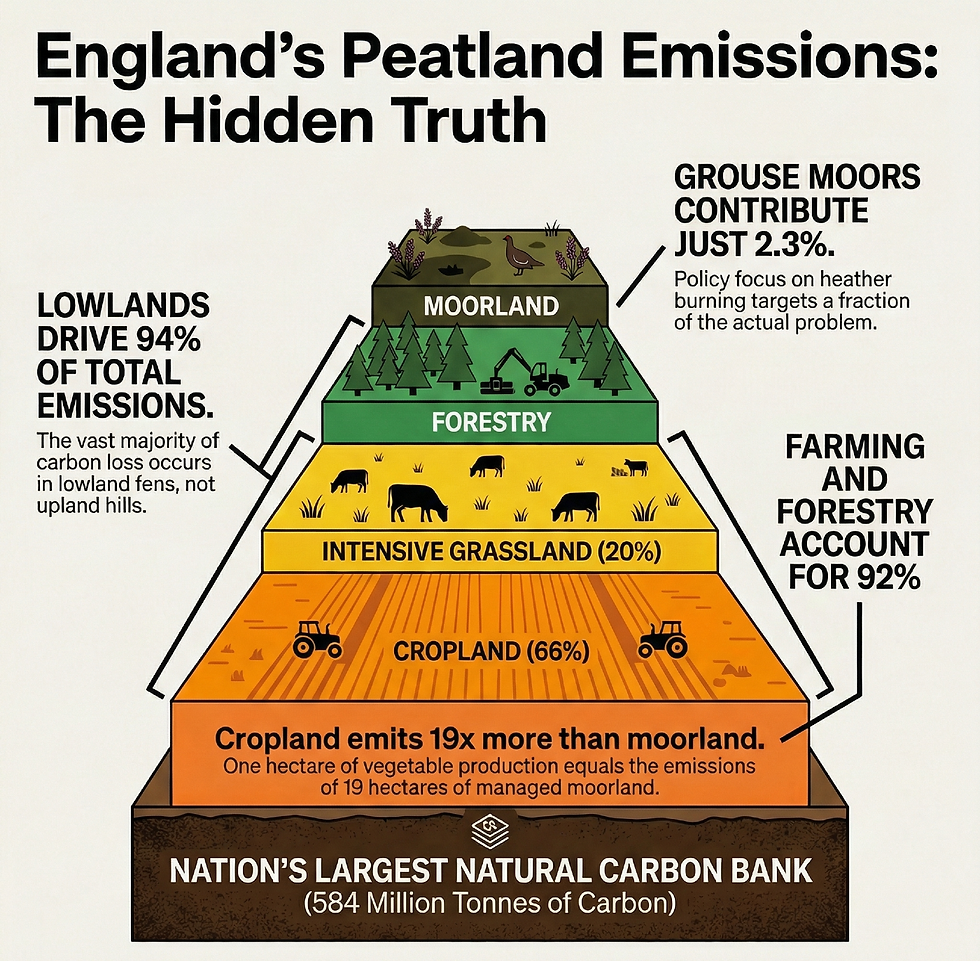
Just 2.3% of England's total peatland greenhouse gas emissions come from heather-dominated moorland - the type of peatland most closely associated with grouse moor management. Meanwhile, peatland converted to cropland, intensive grassland and forestry accounts for over 92%. Yet it is moorland burning that continues to dominate the policy debate.
These figures come from the GWCT Peatland Report, which drew on the most comprehensive UK peatland emissions inventory available at the time of publication (Evans et al., 2017). The data paints a clear picture: the overwhelming majority of peatland emissions in England come not from the uplands but from lowland peat that has been converted to farming and forestry.
England's peatlands cover 11% of the country's land area and store an estimated 584 million tonnes of carbon. That is the UK's single largest carbon store. If all of it were released into the atmosphere, it would be equivalent to around 2.14 billion tonnes of carbon dioxide.
Protecting this store matters enormously - but protecting it effectively means understanding where the losses are actually coming from.
The numbers that matter
The total annual greenhouse gas (GHG) emissions from England's peatlands are estimated at approximately 10.87 million tonnes of carbon dioxide equivalent (CO2e) per year. That is the combined output of every type of peatland in the country, from fenland crop fields to upland blanket bog.
Here is how those emissions break down by peatland type:
Cropland on peat: 66% of total peatland emissions, at 38.98 tonnes CO2e per hectare per year
Intensive grassland on peat: 20%, at 29.89 tonnes CO2e per hectare per year
Forestry on peat: 6%, at 9.91 tonnes CO2e per hectare per year
Heather-dominated modified bog (a proxy for grouse moors): 2.3%, at between 2.08 and 3.40 tonnes CO2e per hectare per year
Those first three categories alone account for 92% of all peatland GHG emissions in England. Heather-dominated moorland sits fourth on the list - producing per-hectare emissions that are a fraction of those from cropland or intensive grassland.
Put another way, a single hectare of peat converted to vegetable production emits roughly 11 to 19 times more greenhouse gas per year than a hectare of moorland managed for grouse.
The lowland problem
Perhaps the most striking finding in the data is that 94% of England's total peatland GHG emissions come from lowland peatlands. Upland peat as a whole - including all blanket bog categories, whether managed, eroded, near-natural or rewetted - accounts for just 5.6% of total peatland emissions.
This is not to suggest that upland peat does not matter. It clearly does, both as a carbon store and as a habitat for some of England's most threatened species. But the scale of the emissions challenge is overwhelmingly a lowland issue, driven by the conversion of deep peat soils to arable farming, intensive grassland and commercial forestry.
The fenlands of East Anglia, for example, sit on some of the deepest and most carbon-rich peat in the country. Decades of drainage and intensive cultivation have turned these areas into major sources of carbon loss.
The GWCT report notes that all peatland types in England are net emitters of greenhouse gases - even near-natural bog produces a small positive emission. But the difference in scale between lowland converted peat and upland managed moorland is vast.
Why this matters for policy
The policy debate around peatland and climate change has focused heavily on vegetation burning on upland grouse moors. Restrictions on burning heather on deep peat have been introduced with the aim of restoring blanket bog. The GWCT report supports the principle of blanket bog restoration where it is possible, but raises concerns that a narrow focus on burning risks missing the bigger picture.
If the goal is to reduce England's peatland emissions as quickly and effectively as possible, the data suggests that the greatest gains are to be found in addressing lowland peat conversion - not in further restricting the management of moorland that contributes just 2.3% of the total.
The report also highlights that grouse moor management brings wider environmental benefits that should be weighed in any policy assessment. Moorlands managed for grouse are strongholds for upland wading birds such as curlew, golden plover and dunlin. The habitat mosaic created by managed burning supports a range of moorland species.
And the people employed on these estates provide the on-the-ground capacity to fight wildfires, restore peatland and protect vulnerable ground-nesting birds from predation.
None of this means moorland management should be exempt from scrutiny. But it does mean that policy should be proportionate and guided by where the evidence points. A management practice responsible for 2.3% of peatland emissions should not attract more policy attention than land uses responsible for 86%.
England's peatlands need protecting. The carbon locked within them is irreplaceable on any human timescale. Getting the policy response right means following the data - and the data is clear about where the priorities should lie.
Don't Miss the Latest Moorland News
Get news of policy shifts, new research and land management changes that affect upland Britain, delivered free every week. If it matters on the moor, you'll hear it from us first.