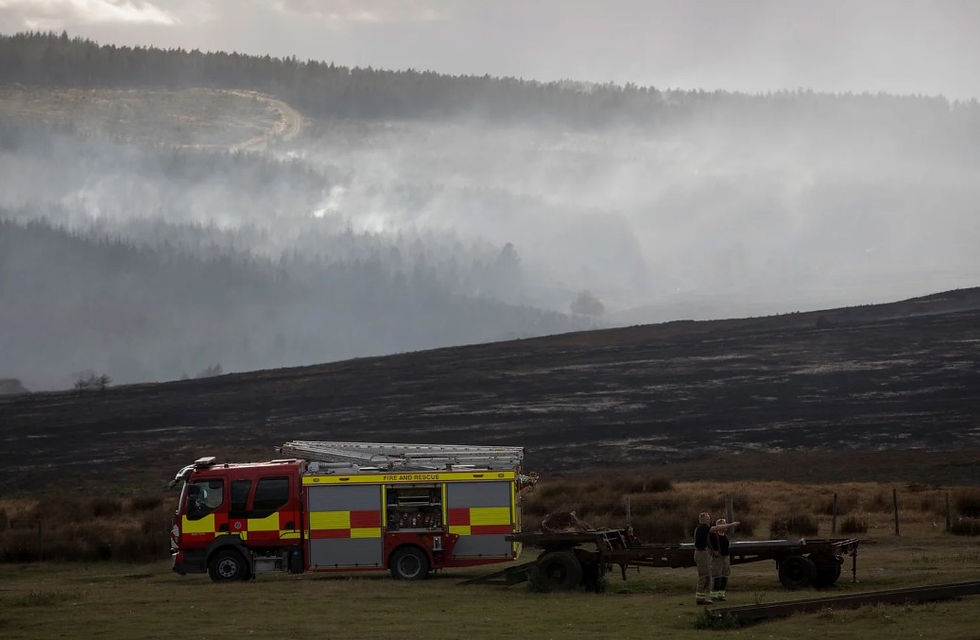
New Climate Change Committee Report: Moorlands Need Practical Wildfire Management


✅ Key Takeaway: The latest CCC report confirms rising wildfire risks demand active moorland management. Relying solely on rewetting is insufficient; practical fuel-load control is essential for effective climate adaptation.
A timely report on a growing risk
The Moorland Association welcomes the Climate Change Committee’s latest report, A Well-Adapted UK: The Fourth Independent Assessment of UK Climate Risk. It is a significant and timely intervention.
Wildfire is no longer a distant or occasional risk. It is now a major climate-adaptation challenge for the UK, with particular implications for upland and moorland landscapes.
For MA members, the report is important because it backs up several points we have been making consistently to Government, Parliament, Defra, Natural England, National Parks and National Landscapes: wildfire risk is rising; moorland regions are exposed; land management affects wildfire outcomes; and practical fuel and fire-risk management must be part of the policy response.
It also gives members authoritative, independent evidence to use in discussions with officials, protected landscapes, local authorities and fire and rescue services.
What the CCC says about wildfire
The CCC reports that 2025 was the UK’s most destructive wildfire season on record, with more than 40,000 hectares burned, including the first UK wildfire over 10,000 hectares, in Scotland.
It also says climate change may already have made UK wildfire conditions at least six times more likely. Looking ahead, the CCC warns that under 2°C of warming by 2050, the number of days with potential conditions for serious wildfire could double, and the wildfire season will become longer, extending into late summer and early autumn.

In plain terms, climate change has already loaded the dice for wildfire, and the CCC says the number of serious fire-risk days could rise further by 2050. The report also identifies particular wildfire risk over the moorland regions of Northern England, Wales and Scotland.
This is highly relevant to the MA’s long-standing argument that wildfire cannot be treated simply as an emergency-response issue. Once a fire takes hold in dry, fuel-loaded moorland, the issue is no longer theory. It is a dangerous, fast-moving incident for land managers, fire crews, rural communities and habitats.
Prevention and mitigation must therefore be built into land management before ignition occurs.
A practical wildfire-management toolkit
The CCC supports that approach. It states that wildfire risk management needs to be built into wider land management and nature restoration, including woodland planting and habitat creation. It also identifies practical wildfire-management tools, including fuel-load management, fire breaks, peat rewetting and ponds.
That matters. Rewetting has a role where it is feasible and effective, and the MA supports it in the right place. But the CCC does not present rewetting as the answer to every wildfire risk. It lists fuel-load management and fire breaks alongside rewetting and ponds.
That should prompt a rethink from those who still continue to suggest that rewetting alone will solve the problem. In many places, it won’t. Wildfire resilience depends on the right mix of tools for the right landscape.
In a future of longer, hotter and drier wildfire seasons, relying on rewetting alone would be a serious mistake. Rewetting has an important role where it works, but it is not a complete wildfire strategy. Fuel loads, vegetation structure, access, fire breaks and emergency response all still matter.
Some will say the CCC does not mention prescribed burning. That is true, but it does not mention cutting or grazing either. The point is that the CCC is not choosing individual techniques. It is recognising the need for fuel-load management.
Nor should policy makers treat every tool other than rewetting as a last resort. The CCC does not rank wildfire-management measures in that way. It recognises fuel-load management, fire breaks, rewetting and ponds as part of the same practical response to a growing risk.
The right question is not which intervention is most fashionable, but which combination of measures will reduce wildfire risk in a particular place.
For moorland managers, that means considering the full range of lawful and appropriate tools: cutting, grazing, bracken and scrub control, fire breaks, rewetting and controlled winter burning.
The same principle should apply to environmental schemes and publicly funded land-management changes. Whether the proposal is rewetting, woodland creation, habitat restoration or changes to grazing, it should include a clear assessment of wildfire risk.
That means asking practical questions: will it reduce or increase fuel loads; will it affect access for fire crews; will it create or remove fire breaks; and will it make a future wildfire easier or harder to contain? Good intentions are not enough if a scheme leaves more unmanaged vegetation available to burn.
Wildfire is a cross-cutting national risk
This matters well beyond moorland management.
Wildfire is relevant to biodiversity, carbon stores, water quality, public health, infrastructure, insurance, emergency response and rural communities. The CCC records that wildfire can affect drinking water quality, carbon storage and public services, and it flags evidence gaps around wildfire health impacts and insurance risk.
Most importantly, the CCC says that cross-government coordination on wildfire is lacking. That echoes a central concern repeatedly raised by the MA: wildfire policy is too often fragmented between departments, agencies and delivery bodies.
Defra, Natural England, local authorities, fire and rescue services, protected landscapes and land managers all have a role. At present, those roles are not joined together well enough.
Support for points made to Parliament and Defra
In our submission to the EFRA Committee wildfire inquiry, we argued that policy must place greater emphasis on reducing wildfire severity before ignition, not simply responding once fires start.
The CCC’s findings support that logic by identifying rising fire-weather risk, particular exposure in moorland regions and the need for wildfire management to be integrated into land management.
In the 2025 Defra consultation on heather burning, the MA argued that regulation must not remove practical fuel-management tools without properly considering wildfire risk. The CCC report does not explicitly list prescribed burning, but nor does it list cutting or grazing.
It supports the fundamental principle that fuel-load management is a legitimate and necessary part of wildfire adaptation. That point is directly relevant to any future Defra policy on heather, peatland and upland vegetation management.
National Parks and National Landscapes must revisit wildfire
The report also strengthens the case for National Park and National Landscape management plans to revisit wildfire.
It is no longer enough for a protected landscape plan to identify wildfire as a risk and then simply ask individual estates to prepare wildfire plans. Estate wildfire plans are important, but they are not a substitute for landscape-scale wildfire resilience.
Protected landscape plans should now set out how risk will be mapped, how fuel loads will be managed, how fire breaks and access will be maintained, how peatland restoration will be designed with wildfire resilience in mind, and how land managers, fire services and public bodies will coordinate.
The message for MA members
For MA members, the message is clear: the national evidence base is strengthening the case we have been making. Wildfire is a climate-adaptation issue. Moorland is on the front line. Active, practical and coordinated land management must be part of the solution.
The MA will continue to press for a wildfire policy framework that recognises the realities of upland management: rewetting where appropriate, but also vegetation and fuel-load management, fire breaks, access, local knowledge, trained personnel and proper coordination between government, agencies and those managing the land every day.
Government, Defra, Natural England, National Parks and National Landscapes should now revisit their approach. Plans alone do not fight fires. Practical management, properly coordinated across whole landscapes, is what reduces risk.