
Fuel Loads, Fire and Why Rewetting Alone Isn't Enough: What MPs Heard on Wildfire

✅ Key takeaway: Witnesses told MPs that cutting wildfire risk depends on managing upland fuel loads — through prescribed burning, cutting and grazing — and that rewetting, though valuable, is not enough on its own.
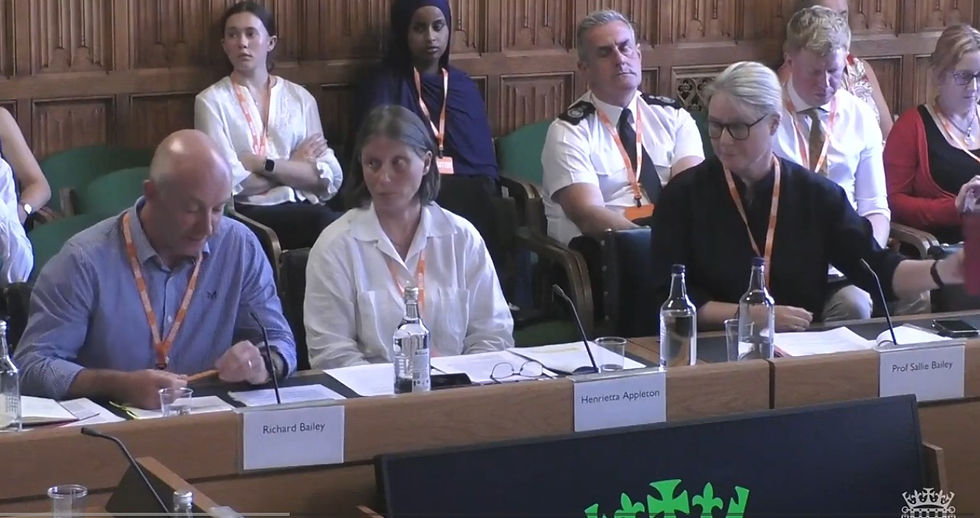
On 23 June 2026 — as amber and red heat warnings spread across England — the Environment, Food and Rural Affairs (EFRA) Committee took oral evidence on wildfire.
Land managers and the Game & Wildlife Conservation Trust set out a pointed case: managing the vegetation fuel load — including, they argued, through prescribed burning — is central to reducing wildfire risk, and rewetting alone cannot close the gap.
The session formed part of EFRA's inquiry into climate adaptation and emergency response. Its timing was, as Chair Alistair Carmichael noted, "seasonal and timely".
Across two panels, fire chiefs, foresters, scientists, a gamekeeper and a policy specialist gave evidence — including on the contested question of how upland land should be managed to reduce the risk.
The human cost
The Chair opened by reading directly from written evidence. One Peak District farmer reported counting more than 80 fires on his land in a single year:
"Six of these have gone out of control to the extent that Derbyshire Fire Services were involved in extinguishing," he wrote, adding that his timesheets showed "over 400 hours in the year, Easter 2025 to Easter 2026" on fire-related incidents, patrolling and clearing.
Richard Bailey, Group Co-ordinator of the Peak District Moorland Group and a gamekeeper of more than three decades, put the risk starkly:
"Unless Westminster stops deliberately building up huge fuel loads of vegetation, it is only a matter of time before somebody is killed."
He described a near-miss weeks earlier, when the Snake Moor fire came within metres of crossing the A57:
"If that had crossed there, and it was a matter of metres, there is no way we would have stopped it. The entirety of the Derwent area, all the way up to Sheffield, would have gone up in smoke."
Fuel loads as the core problem
A recurring theme was the build-up of vegetation — the "fuel load" — that lets a small ignition become a landscape-scale fire.
Rob Gazzard, Wildfire and Contingency Planning Adviser at the Forestry Commission, told MPs that the vast majority of wildfires stay small — a function of fuel condition and rapid response — but that keeping them small is the biggest drain on fire-service resources, and that multiple challenging or extreme fires can stretch national capacity.
He highlighted the role land managers play in cutting firebreaks — what he called "an indirect attack" — at fires including Saddleworth and Langdale, removing fuel ahead of the crews.
MPs and Mr Gazzard also noted a structural gap: no statutory duty to consider wildfire risk in land management, and, as he put it, "no legislation to drive forward wildfire, not in prevention, preparedness, response or recovery."
The case for controlled burning
Mr Bailey argued that prescribed (controlled) burning, done well and at the right time of year, is central to keeping fuel loads down:
"We need to go back to prescribed burning in a sensible fashion at the right time of year. The top scientists from Exeter and York back this up."
Practice has moved on from the hot fires of the past. The burning season runs "October to 15 April, and that is when the peat is wet," he explained; today's "cool burns" are "low-intensity burning, so you are flashing the leaf and dead matter off the surface," leaving "the sphagnum and mosses behind" — sphagnum being the bog moss that builds peat.
He did not present burning as a silver bullet — cutting, grazing and burning all have a place:
"We like cutting, but it needs to be in the toolbox with other methods, grazing and burning."
The skill itself is at risk of being lost. Henrietta Appleton, Policy Officer at the Game and Wildlife Conservation Trust (GWCT), warned that younger gamekeepers increasingly lack the fire knowledge of more experienced colleagues — and that it is precisely "that prescribed burning practice, which has evolved over time, that the fire service is now employing, using and learning from to address wildfires."
Why rewetting alone is not enough
Peatland restoration and rewetting are widely supported for biodiversity, erosion control and peat condition. But, as the MP leading this section, Juliet Campbell, framed it, their effectiveness "as a standalone wildfire mitigation strategy is strongly contested."
Ms Appleton set out the problem of the restoration "gap". Rewetting takes time — restoration timescales are "about 50 years or so" — while the risk keeps building:
"There is a gap between what is happening now and the ambition of a fully restored peatland, and the wildfire risk in that gap is ever increasing."
She pointed to the limits of even successful rewetting. Blanket bogs "naturally drop 20 to 30 cm of their water table depth in the summer" — exactly when the most severe wildfires occur.
And while a wet peat substrate keeps fire on the surface, she noted that this is "very much a carbon argument": it protects the peat "but it does not necessarily stop a wildfire taking the surface vegetation," with heavy losses to ground-nesting birds in spring.
Mr Bailey offered a field example: a deep-peat National Trust site rewetted with plastic dams 13 years earlier.
"Within two yards of these dams, there was peat burning. We were putting out peat."
In his experience, rewetting has never changed an incident commander's decision: he has "never been on a wildfire" where resources were withheld from an area "because rewetting has been carried out."
Witnesses pointed to three limits of rewetting on its own:
Time — restoration runs to decades, leaving a widening gap in protection.
Summer drying — even restored bogs lose much of their water table when the worst fires strike.
Surface fuel — wet peat protects the carbon below, not the flammable vegetation above.
Natural England's case
Professor Sallie Bailey, Chief Scientist at Natural, set out the opposing view. Her central argument: the way to cut fuel load is to remove the flammable monocultures — notably Molinia (purple moor grass) and heather — in the first place.
"Molinia and common heather are a monoculture in some circumstances," she said. "They are very flammable species." Restoring a high water table suppresses them, and healthy, wet peatland does not readily ignite: "Effectively, a wet sponge cannot burn."
Natural England, she said, is beginning a new evidence review on nature-based solutions for wildfire, starting in the uplands, and cited international cases of restored peatlands failing to burn.
Notably, Professor Bailey acknowledged the restoration gap herself, accepting the need to "mind the gap" with alternatives "such as cutting" while water tables recover.
Where the witnesses agreed
For all the disagreement, common ground emerged. All accepted that cutting and grazing are valuable tools; that rewetting is, in Professor Bailey's words, "a step in the right direction"; and that collaborative "fire operations groups" of landowners, NGOs and Natural England work well in the Peak District.
They also agreed on public education and the largely unpaid contribution of rural communities, which Mr Bailey valued at one fire at "just short of £1 million-worth" at no cost to the public.
The Chair closed by warning that upland communities remain unpersuaded, and that policy must "take communities with them". Ms Appleton offered Benjamin Franklin: "An ounce of prevention is worth a pound of cure."
Why this matters
With fire seasons lengthening and fuel loads building, the evidence put to MPs points to a conclusion many of the witnesses drew — reducing wildfire risk means keeping every tool in the box, prescribed burning included, not relying on rewetting alone.


