How Disjointed Government is Fuelling Mega-Fires


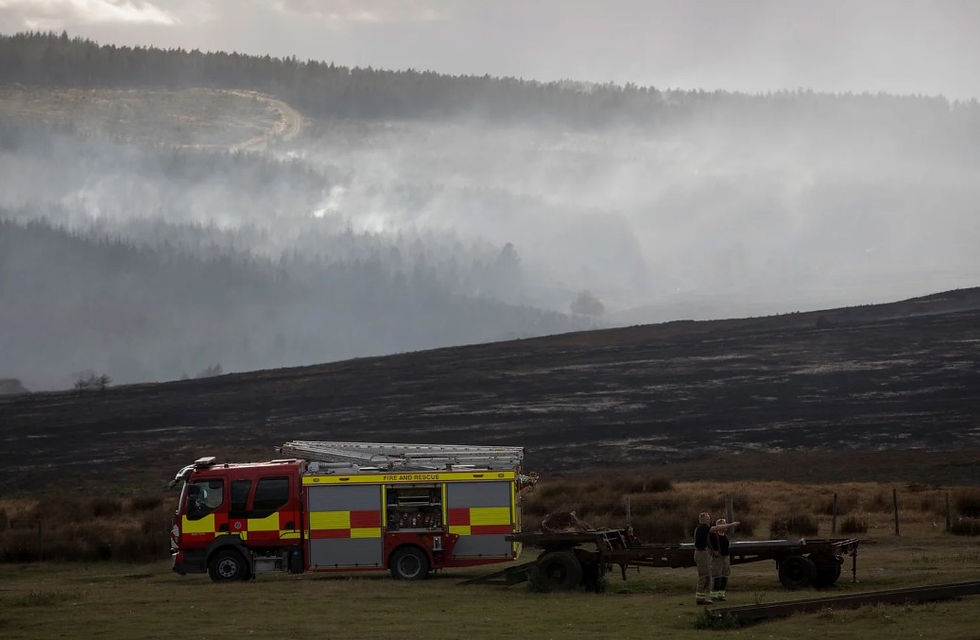
Photo by Scott Wicking
Quick summary
The 2025 season burned 46,000 hectares and cost the UK over £460 million.
MHCLG fights the fires while Defra's rules let dangerous fuel loads build up.
Restricting controlled winter burning creates unbroken “Fire Highways” across Britain's uplands.
A joint statutory Wildfire Resilience Board should replace suppression with proactive fuel reduction.
The record-breaking 2025 wildfire season served as a stark wake-up call, proving that the UK is no longer immune to the mega-fires seen globally. We lost 46,000 hectares of land to the flames, costing the nation over £460 million in emergency response, infrastructure repairs, and environmental devastation.
To prevent this from becoming an annual catastrophe, the Moorland Association proposes the immediate creation of a statutory Wildfire Resilience Board, jointly chaired by the Ministry of Housing, Communities and Local Government (MHCLG) and the Department for Environment, Food and Rural Affairs (Defra).
This Board must be tasked with implementing a statutory Wildfire Severity Reduction Duty. Its core mandate should be to shift our national policy away from a reactive strategy of simply suppressing fires after they ignite, toward a proactive strategy of reducing fuel loads before the first spark is even struck.
We must empower Regional Resilience Partnerships - putting Fire and Rescue Services shoulder-to-shoulder with the farmers, gamekeepers, and land managers who possess the practical expertise and equipment to protect our uplands.
If we do not bridge the current chasm between government departments, we are simply waiting for the next disaster.
A Dangerous Departmental Disconnect
To understand why a joint Defra-MHCLG approach is so desperately needed, we must look at the dangerous contradiction currently at the heart of UK wildfire policy. Put simply: one government department is tasked with fighting the fires, while another is actively creating the fuel that feeds them.
The MHCLG oversees our Fire and Rescue Services. These brave men and women are routinely sent onto remote, inaccessible moorlands to battle towering flames in exhausting, highly hazardous conditions. They are forced to manage crises that threaten lives, homes, and critical national infrastructure.
Meanwhile, Defra and its advisory body, Natural England, continue to enforce restrictive policies that make these fires far more likely to occur and far more difficult to control. By strictly limiting and heavily regulating traditional vegetation management - specifically the practice of controlled, cool winter burning - Natural England is allowing massive amounts of dry, overgrown vegetation to accumulate.
This policy disconnect has created vast, unbroken corridors of highly flammable vegetation across our uplands. We call them "Fire Highways." By preventing land managers from using controlled winter burning to break up these fuel loads and create natural firebreaks, Defra is effectively turning our moors into tinderboxes.
The Cost of Contradiction: 2025 in Numbers
The consequences of this disjointed approach are no longer theoretical. We are living through the fallout. The statistics from the 2025 wildfire season paint a devastating picture of what happens when environmental policy ignores practical fire science.
Unprecedented Scale: 46,000 hectares burned across the UK in a single year.
Staggering Financial Impact: An estimated cost to the country of £460 million, encompassing emergency response, property damage, and the loss of farming and tourism revenue.
A Climate Disaster: Peatland wildfires released 1.3 million tonnes of CO₂, effectively wiping out the carbon savings of hundreds of thousands of electric vehicles and turning our vital carbon sinks into massive carbon emitters.
"Wildfires in 2025 have already surpassed anything we’ve seen before, both in cost and in the scale of damage. These fires are destroying habitats, releasing vast amounts of carbon and leaving communities to pick up the bill. Unless we change course, this will become the new normal." - Andrew Gilruth, Moorland Association Chief Executive
Ignoring the Experts: The "Tinderbox" Reality
The people who fight these fires are begging for a change in strategy. The National Fire Chiefs Council (NFCC) has repeatedly warned the government that limiting land managers’ ability to reduce fuel loads compromises emergency preparedness.
Fire chiefs have called for "strategic decision and policymaking" by central government, noting that heavy fuel loads lead to fires that are simply beyond the capacity of ground crews to extinguish using hand tools.
Restricting controlled winter burning does not remove wildfire risk. It can leave larger, more continuous fuel loads in place, increasing the chance that a future fire burns hotter, spreads faster and becomes harder to control.
The Path Forward: Boots-on-the-Ground Coordination
If we are to answer the EFRA Committee’s call to effectively coordinate wildfire policy across government, the proposed Wildfire Resilience Board must translate cross-departmental cooperation into boots-on-the-ground action.
Common Sense Over Ideology
The spread of responsibility across Defra, MHCLG, and other bodies has allowed a deadly problem to fall through the cracks. We can no longer afford an ideological approach to moorland management that ignores the physical reality of fire behaviour.
By establishing a joint Wildfire Resilience Board, the government can finally align the protection of our environment with the protection of our people. It is time to listen to the fire chiefs, trust the seasoned stewards of the land, and implement a joined-up strategy that fights fire with common sense.