
Defra HRA Consultation: What the Moorland Association is Calling For

The Moorland Association has submitted its response to Defra’s consultation on proposed Habitats Regulations Assessment guidance. This guidance affects how public authorities assess plans or projects that may affect protected moorland.
Why this consultation matters
In simple terms, the HRA is the process public authorities, such as Natural England, use before approving activities that could affect protected habitats sites.
This is an important consultation for members because HRA decisions can directly affect practical upland management, including vegetation management, wildfire-risk reduction, peatland restoration, bracken and scrub control, predator control, grazing, track maintenance and management for qualifying species.
For members, this can influence whether work is approved, what evidence is required, how long decisions take and what conditions are attached.
In practice, many members will experience this through dealings with Natural England, which may be acting as statutory adviser, regulator or decision-maker depending on the case.
However, the relevant public body may also be Defra, a local authority, the Environment Agency, NRW or another authority depending on the consent, licence or permission involved.
The MA’s response makes clear that we support protection of our protected moors. Our concern is not with the HRA process itself, but with the way it can sometimes be applied in practice: inconsistently, repetitively, slowly or without enough regard to the realities of moorland management.
What the MA response says
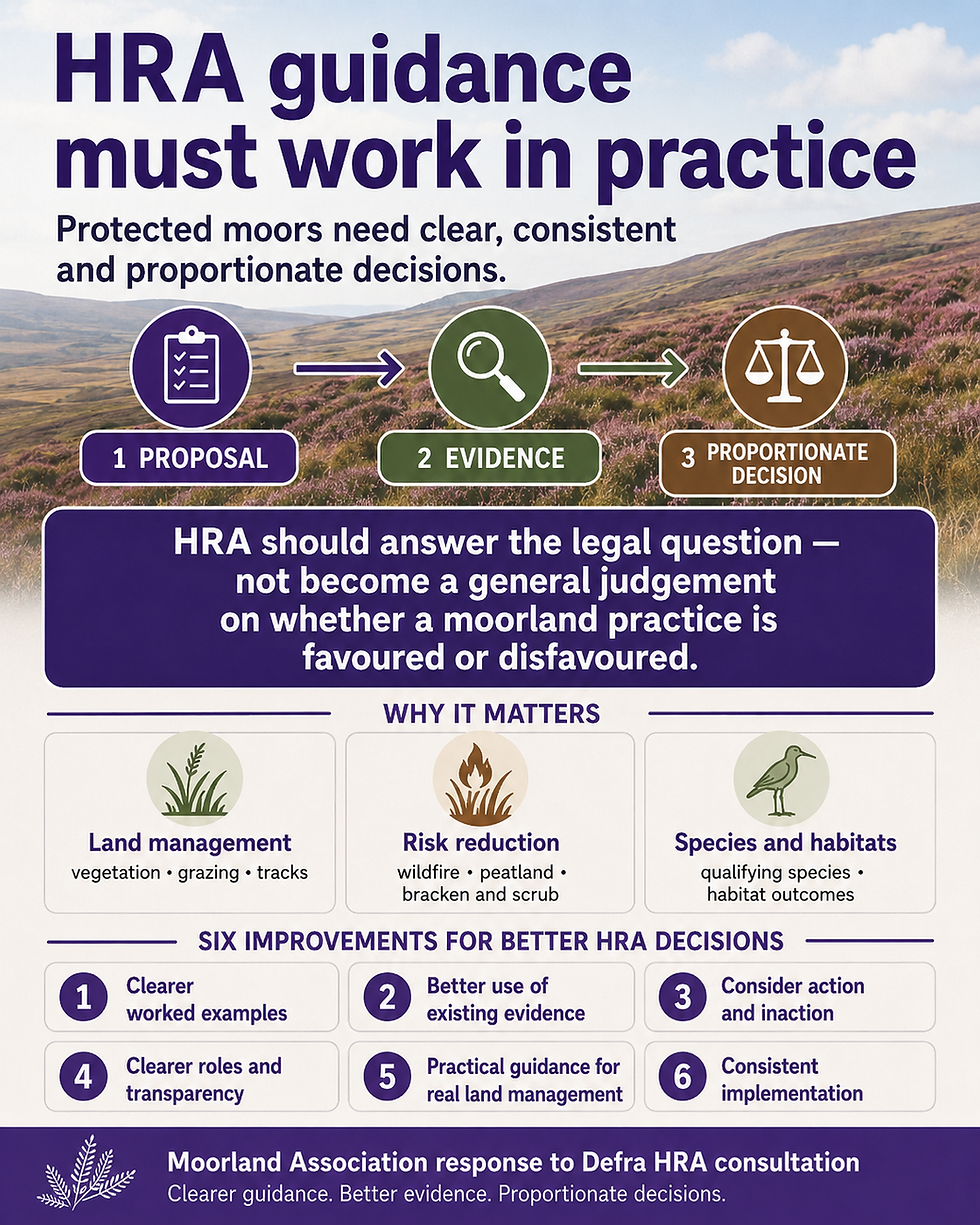
We have argued that the HRA should remain focused on the legal question: whether a specific plan or project could affect a protected habitat or species feature of a protected site, in view of that site’s conservation objectives. It should not become a general policy judgement on whether a particular moorland practice is favoured or disfavoured.
Managing moorland means managing risk
A central theme of the MA’s response is that upland management often involves choosing between ecological risks, not between risk and no risk. Delaying or refusing management can itself create environmental risk, including increased fuel load, wildfire risk, bracken or scrub encroachment, peat deterioration, delay to restoration, or loss of suitable habitat structure for qualifying bird species.
What we have asked Defra to improve
The response asks Defra to strengthen the guidance in several key areas.
1. Clearer worked examples
We have called for clearer worked examples, especially for upland land-management cases. Members’ experience is that, without practical examples showing how HRA tests should be applied, decision-making can become more cautious and inconsistent than it needs to be.
Worked examples would help public bodies and applicants distinguish real risks from hypothetical concerns, understand what evidence is genuinely needed and apply the tests consistently.
2. Better use of existing evidence
We have asked for better use of existing assessments and evidence. Where a previous HRA, consent, licence decision, management agreement or monitoring record remains relevant and up to date, it should not be disregarded or repeated unnecessarily.
At the same time, previous HRA reasoning should not be repeated uncritically if site conditions, evidence or the proposal itself have changed.
3. Considering action and inaction
We have stressed that competent authorities (the public bodies making the decision) should consider both action and inaction. This is especially important for wildfire risk, where the timing or ignition point of a future fire may be uncertain, but the consequences for peatland, habitats and species can be severe.
4. Clearer roles and greater transparency
We have asked Defra to clarify the roles of applicants, competent authorities and statutory advisers. Applicants should provide proportionate, site-specific information. The legal assessment and final HRA conclusion belong to the competent authority.
The response also asks for greater transparency where advice from Natural England, NRW or another statutory nature conservation body materially influences the decision.
5. More practical guidance for real land management
We have asked for more practical guidance on mitigation, reasonable scientific doubt, site integrity, conservation objectives, emergency action, adaptive management and recurring land-management activities, so that decisions are based on the real proposal and the real site evidence.
6. Consistent implementation
The MA has also asked Defra to ensure the revised guidance is not only published, but implemented consistently through training, shared case studies and decision-record examples. Guidance will only help members if it changes day-to-day practice.
The submission does not argue against careful assessment. Instead, it asks Defra to make sure the assessment is focused on the right question, uses relevant evidence, avoids unnecessary repetition and properly considers the consequences of both action and inaction.
What happens next?
Defra will now consider consultation responses before finalising the guidance. The existing rules continue to apply until Defra publishes new guidance. We will update members when the final guidance is published and explain what it means for moorland management, consents and licensing in practice.
Our position
In summary, the MA’s position is that HRA should continue to protect habitats sites. The issue is not whether protected sites should be safeguarded, but whether the process is applied clearly, consistently and proportionately. Clearer guidance is needed so that necessary and beneficial moorland management can be assessed lawfully, proportionately and consistently.


