
New EFRA Committee Call for Evidence on the Uplands: Why MA Members Should Consider Responding

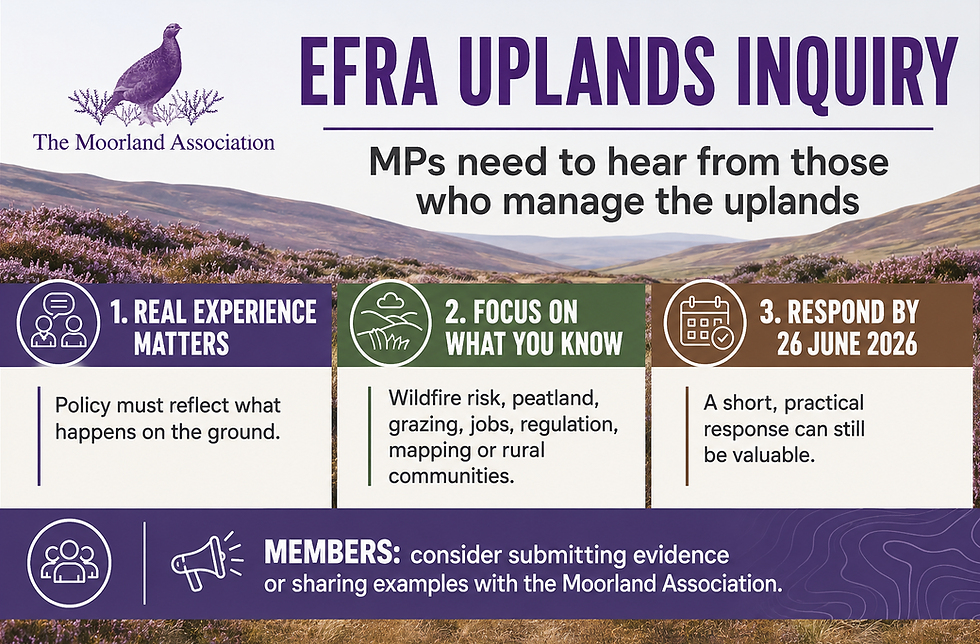
✅ Key Takeaway: Moorland managers - shape future policy by submitting your practical, on-the-ground experiences to the EFRA Committee’s Call for Evidence on the uplands before the 26 June 2026 deadline.
The House of Commons Environment, Food and Rural Affairs Committee (EFRA) has launched a new call for evidence on the future of upland farms and landscapes.
This is a timely opportunity for Moorland Association members to ensure MPs hear directly from those who live, work, invest and manage land in the uplands.
The deadline for submissions is 26 June 2026.
What members can do
Members may wish to take one or more of the following steps:
submit their own short written response to the Committee
offer to give oral evidence, if they have direct experience that would help MPs understand upland management in practice
send comments, examples or evidence to the Moorland Association to help inform our response
A response does not need to be long or technical. A short note setting out your own experience, the issues you see on the ground, and what you think Government needs to understand can be very useful.
Why this matters to moorland managers
This inquiry is directly relevant to Moorland Association members.
Upland policy is often discussed in abstract terms: carbon, nature recovery, peatland restoration, water, access and climate targets. All of these issues matter. But they are also inseparable from the people and businesses who manage these landscapes every day.
The Committee has specifically said it wants to hear from the people who know these communities and landscapes best. That makes the real lived experience of moorland managers, farmers, keepers, commoners, contractors and rural businesses particularly important.
Members can help explain what national policy looks like on the ground: what works, what does not, where regulation is helping, where it is creating unintended consequences, and how Government can better support practical, sustainable upland management.
You do not need to answer every question
The Committee has published suggested questions, but these are guidance. You do not need to answer them all, and you do not need to use formal policy language. The most useful evidence is often clear, practical and grounded in direct experience.
Members may wish to focus on one or two points they know well, such as:
the impact of agri-environment changes on upland businesses;
the role of grouse moor management in sustaining rural employment;
the importance of grazing, keepering, predator control and vegetation management;
wildfire risk and the danger of allowing fuel loads to build up;
peatland management and the need for site-specific approaches;
the impact of designations such as SSSIs, SACs, National Parks and Protected Landscapes;
problems with mapping, modelling or remote assessments that do not reflect conditions on the ground;
the need for Defra and Natural England policy to be better aligned;
how land use change could affect local communities, skills, jobs and private investment.
Even one well-explained example from your own experience can help the Committee understand how policy affects upland management in practice.
The aim is not to produce a technical report, but to help MPs understand the practical realities of managing the uplands.
Offering oral evidence
Members may also wish to indicate in their written response that they would be willing to give oral evidence to the Committee.
Oral evidence sessions allow MPs to hear directly from people affected by policy. For this inquiry, that could include those managing moorland, peatland, grazing systems, wildlife, access, wildfire risk and rural employment on a daily basis.
Saying that you would be willing to give oral evidence does not mean you will automatically be called to appear. It simply helps the Committee identify people with practical experience who may be able to assist MPs.
If you have direct experience that would help the Committee understand the realities of upland management, it is worth making that clear in your written response.
Real lived experience is important to this inquiry, and members should not underestimate the value of explaining what policy means in practice on the ground.
How to submit evidence
Submitting evidence is straightforward.
You simply need to write your response in a Word document and submit it through the EFRA Committee website.
The Committee’s call for evidence page sets out the questions it is interested in. You can respond to those questions directly, or make your own points if there are issues you think MPs need to understand.
The deadline is 26 June 2026.
The Moorland Association’s response
We will be submitting a formal response to the inquiry and intend to cover the importance of recognising the uplands as working landscapes, not simply as spaces for delivering national environmental targets. Our response will make the case for balanced policy that supports food production, nature recovery, peatland management, wildfire prevention, water management, public access, rural employment and private investment.
We expect to include points on:
Working upland landscapes. Upland areas are shaped by generations of active management. Farming, grazing, moorland management and sporting interests all play a role in sustaining the character, economy and ecology of these places.
The upland economy. Grouse moor management supports jobs, skills, contractors, tenant farmers, local services and rural communities. Policy decisions that affect moorland management can therefore have consequences well beyond the moor itself.
Wildfire risk. Wildfire must be central to any discussion about upland land use. Policies that increase vegetation fuel loads without adequate management or fire-and-rescue capacity could increase the risk of severe, damaging wildfires.
Peatland and vegetation management. Peatland policy needs to be practical, evidence-led and site-specific. Restoration, rewetting, cutting, grazing, burning and wildfire prevention all need to be considered in context, rather than through blanket assumptions.
Agri-environment schemes. These must be designed around the practical realities of upland systems. They need to be flexible enough to support active land management, long-term business planning and measurable environmental outcomes.
Regulation and designations. Protected area designations and regulatory decisions have a major impact on land management. We will highlight the need for proportionate, joined-up decision-making from Defra, Natural England and other bodies.
Data, mapping and modelling. Land use decisions must be based on accurate, ground-truthed information. Remote mapping and modelling can be useful, but they must not override practical local knowledge or misrepresent peat depth, vegetation condition, wildfire risk or management constraints.
Rural communities. Changes in upland land use can affect employment, housing, skills, schools, services and the viability of rural communities. These social and economic impacts must be properly understood.
We welcome members’ views
The Moorland Association will publish an initial draft of its response for members to comment on next week.
We would welcome thoughts, examples and evidence from members on the points we should include in the MA response. In particular, practical examples from your own experience will help strengthen the case.
We would particularly welcome case studies, figures, photographs, short notes or practical examples showing where current policy is helping or hindering good upland management.
Examples of unintended consequences, local economic impacts, wildfire risk, environmental improvements, regulatory barriers or successful management approaches would all be
useful.
Please send your thoughts to agilruth@moorlandassociation.org.
This is a valuable opportunity to ensure that Parliament hears directly from those who manage and understand the uplands. Members are strongly encouraged to consider submitting their own response, however brief, and to let the Committee know if they would be willing to give oral evidence.


