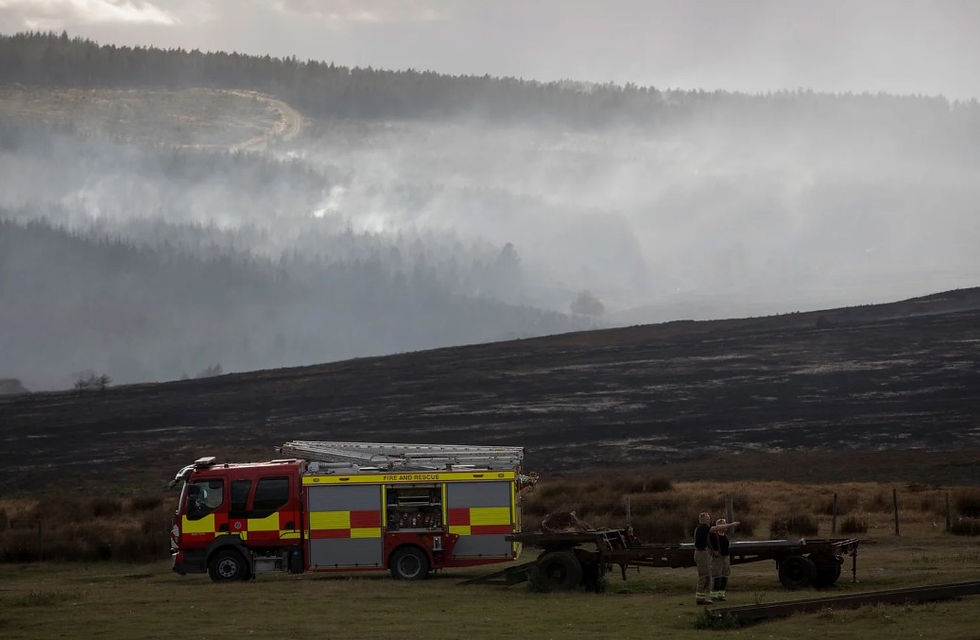
Prevention Is the Cure. The UN Disaster Office Backs Controlled Burning


Quick summary
The UN's disaster risk office says prevention is the cure for wildfires, and backs controlled burning.
In 2025 the UK signed a G7 commitment calling for controlled burning to reduce wildfire risk.
The USA is easing its restrictions, and European Commission guidance accepts prescribed burning on temperate heathland.
England still restricts burning on heather moorland, and the MA wants Defra and Natural England to change that.
Earlier this year, the UN Office for Disaster Risk Reduction (UNDRR) published ten fundamentals for cutting wildfire risk. Their author is Kamal Kishore, the UN Secretary-General's Special Representative for Disaster Risk Reduction.
The first fundamental is that, for wildfires, prevention is the cure. The second concerns controlled burning, also called prescribed burning. Both terms mean planned, carefully managed fire used to reduce the build-up of flammable vegetation.
The UK joined a G7 commitment in 2025 that called for controlled burning. In England, regulation continues to restrict and discourage it on heather moorland.
What the UN says about controlled burning
Kishore writes that even countries with the most advanced firefighting capacity struggle to contain a wildfire once it is fully underway. He argues for investing earlier.
"Countries that invest in fire prevention see a marked decrease in fire prevalence and damage."
Kamal Kishore, Special Representative of the UN Secretary-General for Disaster Risk Reduction, UNDRR
He points to Portugal. Its post-2017 national wildfire plan shifted the focus to prevention, and burned areas fell significantly in the years that followed, even in the severe 2025 season.
Kishore notes that controlled burning has been used in forest management for millennia to clear undergrowth and remove dry fuel.
His solution is to plan burns using traditional knowledge, modern management practice and fire-danger forecasting. That describes trained, experienced practitioners working to a plan.
UNDRR's own guide to reducing wildfire risk before a blaze begins goes further. It says prescribed burning and Indigenous land management practices "play a key role in reducing fuel loads and mitigating extreme wildfires". The same guide recommends targeted grazing to cut flammable vegetation.
UNDRR also curates a controlled burning collection on its PreventionWeb platform. It brings together research and reporting from Stanford University, Northern Arizona University, the University of Connecticut and the journal Fire Ecology, among others.

Key facts from the UN
Work to reduce excess flammable vegetation in western US forests averted nearly 60 premature deaths, 2.7 million tons of carbon dioxide emissions and US$2.8 billion in damages, according to UNDRR's Wildfire Portal.
A Stanford-led study, shared in UNDRR's controlled burning collection, found California could cut deadly smoke pollution from wildfires by 20% in active fire years by expanding prescribed fire in conifer forests.
The Wildfire Portal reports that in some regions, land-use change and the abandonment of rural land have increased the amount of vegetation available to burn.
Munich Re estimates wildfires cost the world US$136 billion between 2015 and 2024, a figure Kishore cites.
The rest of the world is already doing it
The G7
In June 2025, the then British Prime Minister Sir Keir Starmer joined the other G7 leaders in Kananaskis, Canada. Their formal agreements included a shared wildfire commitment. It called for controlled burning to "reduce the risk of extreme wildfires" and recognised Indigenous and cultural burning.
The same month, the US President ordered the Environmental Protection Agency to look at removing restrictions on preventative prescribed fires. Our blog post on the G7's backing for controlled burning sets out the detail.
The European Union
Recent European Commission guidance on Natura 2000 and climate change takes a similar view, though it is not binding in the UK. It says fuel management can include thinning, prescribed burning and extensive grazing, and that wildfire prevention should be a planning priority.
The guidance accepts well-planned prescribed burning as a legitimate, cost-effective tool in some habitats adapted to low or mixed-severity fire, including temperate heathlands.
On bogs and mires, it puts restoration and rewetting first. Its approach is habitat-based and site-specific, as our analysis of the new EU wildfire guidance explains.
The UK is the odd one out
Controlled burning still takes place in England under rules and licences. The MA's view is that Natural England's approach to regulation has drastically reduced how much burning happens, and that it treats rewetting as the main answer to wildfire.
MA members support rewetting. They have blocked more than 7,000km of old agricultural ditches. Rewetting and fuel management work best together, which is how other governments treat them.
The 2018 Saddleworth Moor fire started on land where Natural England allowed controlled burning only once every 23 years. On Dartmoor, an independent review published by Defra warned that excess vegetation was turning the moor into a "tinderbox". A wildfire on Dartmoor followed months later.
The UK supports controlled burning in international agreements while restricting it at home. The USA is easing its restrictions, and the European Commission accepts burning on heathland. England is heading the other way.
What needs to change
The UK has already signed up to the international case. Defra and Natural England should now apply it in England by:
Stating in England's wildfire and peatland policy that controlled burning is a recognised wildfire prevention tool, consistent with the G7 commitment.
Making burning decisions site by site, based on habitat and fuel load, as the European Commission guidance does. That means controlled burning, cutting and grazing on fire-prone heather, and rewetting on bogs and mires.
Basing burning rules on wildfire risk, so managers can reduce fuel on high-risk ground before it reaches dangerous levels.
Treating gamekeepers and moorland managers as part of the wildfire workforce. Kishore says communities who care for the land and act as first responders are central to reducing risk.
MA members manage more than one million acres of heather moorland and do this work every season. They want to help Defra and Natural England get it right.