Rewetting Is Important. But on Its Own, It Won't Stop Moors from Burning

Video by Peak District Moorland Group
Key takeaways
Rewetting protects peat carbon but doesn't remove flammable heather, gorse, or grass canopy fuel above ground.
Restored sites like Marsden Moor still burned repeatedly, showing rewetting alone doesn't stop surface fires.
Surface fuel moisture depends on weather, not water tables, so canopy can ignite even over saturated peat.
Effective wildfire prevention needs an integrated toolkit: rewetting, cutting, licensed burning, and firebreaks together.
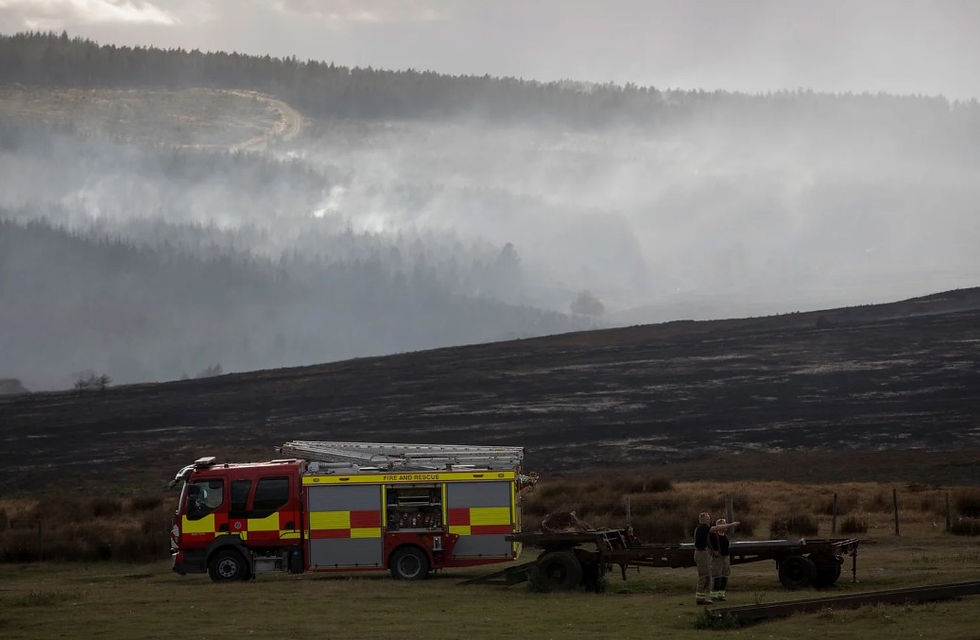
In April 2019 a wildfire tore across Marsden Moor in West Yorkshire, a site under active National Trust restoration, with gullies blocked, leaky dams installed and extensive Sphagnum planting, and where controlled burning is not used.
It burned regardless. And it kept happening: a University of Manchester study records large wildfire events on the restored estate in February and April 2019, March 2020, April 2021 and twice in March 2022, with the Trust reporting some £700,000 of cumulative damage since 2019.
Restoration was working as intended, and the surface still burned.
None of this means rewetting fails. It means we are asking one tool to do a job it cannot finish alone.
What rewetting is — and what it genuinely does
Rewetting raises a peatland's water table back toward the surface, usually by blocking the drainage channels ("grips") and erosion gullies cut into blanket bog over the last two centuries. Wetter peat oxidises less, loses less carbon, and over time favours the peat-forming Sphagnum mosses that make a healthy bog.
For fire, the benefits are real:
It cuts the risk of deep, smouldering peat fire. The destructive, hard-to-extinguish fires that consume ancient carbon are smouldering ground fires; saturated peat resists them.
It reduces severity where the water table is genuinely raised. A 27-site Scottish study found blanket bog and wet heathland resisted severe burning, while drier heaths took the worst damage — a pattern echoed by findings that heathland on drier organic soils burned most severely and that Sphagnum lends wet moorland its resilience.
Living Sphagnum is a poor fuel and a moisture store, resisting ignition and recovering quickly after fire.
So a mature, wet, Sphagnum-rich bog is our best long-term defence against the deepest, most carbon-costly fires. The Moorland Association is pro-restoration. The question is not whether rewetting helps — it does — but whether it is sufficient, and fast enough, on its own.
Why it isn't enough on its own
1. Rewetting doesn't remove the fuel
Raising the water table acts beneath the peat. It does nothing to the flammable canopy and litter above it — heather (Calluna), purple moor-grass (Molinia), gorse and dead litter.
That surface layer is what carries a moorland fire, and fuel load and structure are primary controls on flame length and rate of spread: older, degenerate heather carries far more woody and dead material than young growth, and Molinia leaves a dense mat of cured litter that dries to tinder.
Only cutting or burning removes that fuel. Nor does wetting the ground reliably kill it off: a 2025 review found the claim that rewetting reduces heather dominance and thereby protects against wildfire is unsubstantiated — heather can hold dense cover on wet bog.
Takeaway: A rewetted bog still carrying rank heather, gorse or Molinia litter keeps a continuous, flammable fuel bed — even while the peat below is wet.
2. Surface fuel dries independently of the water table
The canopy has its own moisture, set by the weather, not by a water table a metre below. Heather's lower dead canopy fails to sustain fire above about 70% fuel moisture but ignites and spreads readily below about 60% — "fuel moisture" being simply how dry the vegetation is.
That threshold is crossed easily: moss and litter moisture can swing above and below their ignition point within a single day. Early spring is the danger window.
Work by Davies and colleagues (2010) on the winter desiccation of Calluna describes how bright, dry, frosty conditions strip moisture from live heather while frozen ground blocks the roots from replacing it, so the canopy can turn flammable even as the peat beneath stays saturated or frozen.
Takeaway: A high water table does not keep the elevated, dead surface fuel wet. The fire's fuel can be tinder-dry while the bog is soaked.
3. Rewetting is slow — and the fires come in the droughts
Restoration is not a switch. Holden's synthesis of grip-blocking work (2009) found that even where the mean water table recovers quickly, its day-to-day behaviour can still be unlike intact bog several years after blocking.
A later Exeter study confirmed the direction of travel while sounding the same caution: restoration increases water storage and reduces dry-season drawdown, but does not guarantee an immediate reversal of long-term degradation.
Vegetation and soil lag further still: one Southern Pennine site had not recovered an intact-bog microbial community even 25 years on.
For years to decades, a site is neither fully wet nor carrying a protective Sphagnum lawn — yet the worst fires strike in exactly the prolonged droughts when even restored peat draws down at the surface and rewetting's protection is weakest.
Takeaway: Through the long transition, and in the drought years that matter most, rewetting's shield is only partly up.
The evidence from real fires
Restored ground still burns. Marsden Moor is the clearest case: active restoration, no controlled burning, and repeated significant wildfires from 2019 to 2022. These were spring, public-access ignitions, so ignition pressure, not just fuel, is part of the story, and there is no controlled counterfactual. But restoration-in-progress plainly did not prevent fire.
Where wetting had taken hold, fires burned less severely. After a Peak District blaze, the Peak District National Park Authority reported that the wettest area — where peat mini-dams held water on the moor — was significantly protected, reducing the fire's impact. Restored ground was inside the fire's footprint and burned, but it burned less badly where the water table had genuinely risen.
These cases are observational, not controlled experiments, and wetter patches often did fare better. That is the honest reading: rewetting reduces severity and depth; it does not prevent surface fire from starting and spreading.
European wildfire monitoring (EFFIS) also records 2025 as a record UK year for area burned, a reminder that the fires increasingly arrive in the extreme dry windows where restoration's benefits are most easily overtaken.
The toolkit that actually works
If rewetting cannot remove surface fuel, something else must. No single tool covers the whole risk, so the answer is an integrated, site-by-site toolkit:
Rewetting — the only tool that addresses peat moisture and the deep-smouldering risk. Slow; leaves surface fuel intact.
Cutting/mowing — removes standing fuel without fire and creates firebreaks; suitable on deep peat where burning is not. But cut material left as litter can itself become a wildfire hazard once dry and cutting is not possible on inaccessible or rocky terrain.
Licensed prescribed burning — removes surface fuel most completely and maintains a fine-grained age mosaic. It works by consuming the elevated canopy quickly while the ground layer stays damp, and the wider fire-science picture is reassuring on downward heat: a global evaluation of soil heating found that in real fires, heat penetrates soil far less than laboratory tests imply, because soil conducts heat poorly. (That study measured mineral soils; how far it carries to organic peat is exactly the kind of thing burn prescriptions must judge site by site.)
Firebreaks and ignition control — most UK wildfires are human-caused, so access management, signage and patrols matter; no vegetation treatment removes the spark.
What this means for policy
The policy question is not "rewetting or management." It is which combination of tools reduces the specific risks on this site. Every high-risk upland unit should have an integrated, site-specific wildfire plan.
Blanket restrictions on managing surface vegetation on deep peat is letting dangerous levels of fuel accumulate — and the climate trajectory points to a longer, more dangerous fire season.
Why this matters
Get this right and we protect the carbon in the peat and the people, wildlife and water downstream of the next fire.
Get it wrong — by treating a wet water table as the whole answer — and we leave the flammable canopy standing until a drought sets it alight, and lose in days the peat we spent decades trying to save.