What the Langholm Moor Demonstration Project Revealed About Grouse, Raptors and Moorland Economics

Quick summary
Over ten years, Langholm restored heather and saw hen harriers, merlins, curlew, golden plover and snipe increase.
Red grouse rose four- to five-fold by 2014, then nearly halved, and none were ever shot.
Low adult and chick survival, not habitat, held grouse back; diversionary feeding helped but not enough.
Without a shootable surplus, driven shooting could not fund roughly £230,000 a year of management.
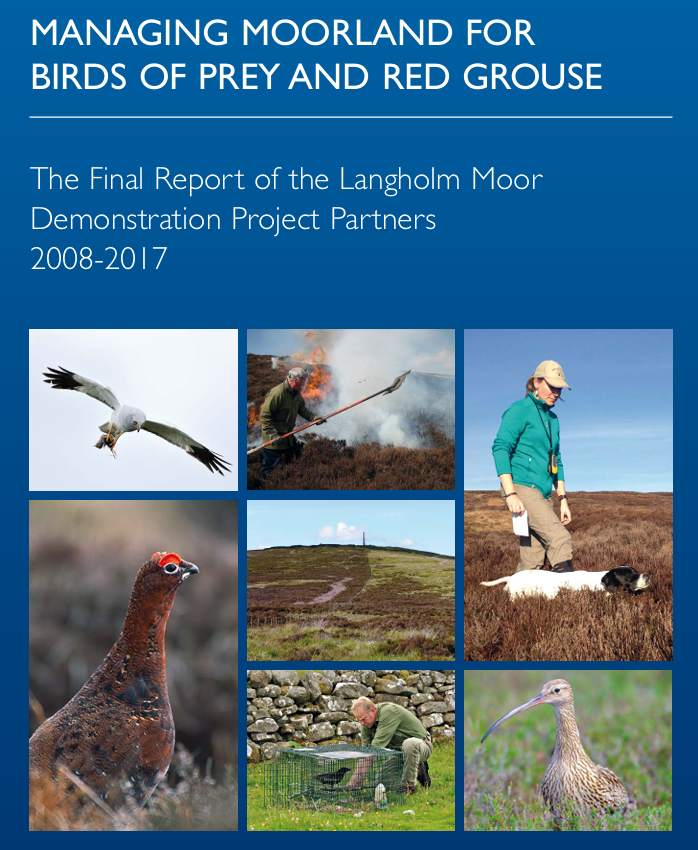
The Langholm Moor Demonstration Project set out to test one of the most difficult questions in upland management: could a moor support breeding birds of prey, recover its heather habitat and produce enough red grouse for driven shooting to fund that management?
After ten years, the answer was mixed. Management restored substantial areas of heather, reduced fox and crow numbers and coincided with increases in hen harriers, merlins and several declining waders.
Red grouse also increased initially. But they never became abundant enough to provide a sustainable shootable surplus, and no grouse were shot during the project.
This is important because the project was not simply testing whether grouse moor management could deliver conservation gains. It was testing whether those gains could ultimately be supported by income from driven grouse shooting. At Langholm, under the conditions and management options available, that economic model could not be established.
Testing whether raptors and driven shooting could coexist
The project ran from 2008 to 2017 on Langholm Moor in south-west Scotland. Its partners were Buccleuch, Scottish Natural Heritage, the Game & Wildlife Conservation Trust, the RSPB and Natural England.
Its core objective was “to establish Langholm Moor as a driven grouse moor” while meeting the conservation objectives of the Special Protection Area and Site of Special Scientific Interest. It aimed to maintain hen harriers, improve heather habitat and produce enough grouse to make continued management financially viable.
Five gamekeepers and a project manager worked across an 11,492-hectare study area, including around 4,200 hectares of core grouse beats. Management included reduced grazing, muirburn, cutting and heather restoration, alongside grouse health measures and legal predator control.
Fox abundance was reduced by around 80% and crow abundance by 65% while predator control continued. Hen harriers were also provided with diversionary food in an attempt to reduce their consumption of grouse chicks.
Decades of heather loss were reversed
Habitat recovery was one of the clearest successes.
Between 1948 and 2009, heather-dominated vegetation at Langholm had declined by 73%, during a period that included heavy sheep grazing. After grazing pressure was substantially reduced from 2011, the direction of change reversed.
By 2015, heather-dominated habitat had increased by 26%, although it remained at only about one-third of its 1948 extent.
A separate analysis found that reduced grazing together with burning, cutting and, in some areas, reseeding increased total heather cover by 10% and the area dominated by heather by 30% within six years. Grouse densities were generally higher where there was more heather.
But more heather did not translate into better grouse survival. The researchers found no relationship between heather cover and grouse survival, and no consistent relationship with productivity.
The report therefore concluded that habitat restoration could increase the moor's capacity to support grouse, but would not by itself solve the demographic problems holding the population back.
Curlew, golden plover and snipe increased
Several breeding waders responded strongly during the project.
Over the ten-year study period, curlew numbers increased by an average of 10% a year, golden plover by 16% and snipe by 21%. Lapwing numbers did not change. These trends contrasted with regional and national declines in all four species over the same period.
The researchers found that the increases in curlew and snipe were not related to whether areas received grouse habitat management, suggesting that predator control operating across the wider study area was the more likely explanation.
Recovery was incomplete. Curlew, golden plover and snipe remained below the project's original targets. The authors suggested that low starting populations, delayed recruitment, limited and isolated suitable habitat and incomplete predator removal may all have restricted the rate of recovery.
Ground-nesting raptors also benefited
The project provides an important distinction between different types of raptor.
A 27-year analysis of Langholm found that hen harriers and merlins increased during periods of grouse moor management and had a higher proportion of successful nesting attempts. Fox predation was the main recorded cause of breeding failure when foxes were not controlled.
By contrast, management did not measurably alter the abundance or breeding success of peregrines, buzzards or ravens, which nest on crags or in trees.
The Langholm evidence therefore does not support a simple assumption that management for red grouse necessarily conflicts with raptor conservation. At this site, legal predator control was associated with better outcomes for some ground-nesting birds of prey as well as for waders and grouse.
Grouse increased, but survival remained too low
Red grouse densities increased four- to five-fold between 2008 and 2014, but then fell by almost half. The annual pattern was inconsistent, and the increase was not sufficient to allow shooting.
Each year, the project board considered the summer counts and decided that adult and chick mortality was too high to remove grouse without risking the breeding population. No grouse were therefore shot at any stage.
Demographic analysis pointed towards adult and chick survival as the main constraint. Clutch size, nesting success and hatching success contributed relatively little to annual population change. Of grouse carcasses examined, 82% showed signs associated with raptor predation or scavenging.
That wording is significant. Finding raptor signs on a carcass does not always establish whether the bird was killed or subsequently scavenged. The project partners themselves identified the distinction between predation and scavenging, the contribution of individual raptor species and the possible influence of factors such as weather as areas where uncertainty remained.
Diversionary feeding worked, but did not solve the problem
Diversionary feeding changed what hen harrier chicks ate.
Harriers consumed 76% of the supplementary food provided. Depending on the method used to assess diet, diversionary food made up 44–53% of food consumed by nestlings, while red grouse chicks accounted for 0–4% of food items.
The researchers estimated that feeding reduced the number of grouse chicks delivered to harrier nests by 34–100%, although the confidence intervals around those estimates were large.
It demonstrated that feeding could reduce hen harrier predation on grouse chicks. It did not, however, improve overall grouse productivity sufficiently to create a sustainable shooting surplus.
The economics determined whether management could continue
Routine moorland management cost roughly £230,000 a year. Across the project, around £2.25 million was spent on routine management and approximately £1.5 million on capital investment.
The project used 1,000 brace shot in a season as an interim target for attracting sufficient private investment, although the report estimated that around 3,000 brace would have been required to reach full economic break-even.
In practice, the moor never came close to either target.
The report calculated that even a bag of 100 brace would have needed to generate £150,000, or £750 per bird, merely to cover half of the annual management cost. That was more than ten times the reported 2019 market price.
The board ended predator control, grouse disease control and active habitat management after February 2016 after concluding that there was no realistic prospect of reaching the required grouse density within the project's timeframe using the available management options.
Langholm should not be treated as a verdict on every grouse moor. It was a large, relatively isolated site with depleted heather and very low grouse densities at the outset.
Nor does the report establish the general economic effect of raptors, something its authors explicitly say would require experimental evidence.
What it does show is more specific. Intensive management at Langholm restored heather and was associated with recoveries in several important upland birds. The unresolved problem was how to finance that management when red grouse survival remained too low to allow driven shooting.