
When More Trees Mean Less Carbon
- Andrew Gilruth

- Jun 2
- 10 min read

✅ Key Takeaway: Tree planting on carbon-rich moorland soils can release more carbon than the trees store; demand full soil carbon accounting before supporting woodland creation or rewilding schemes.
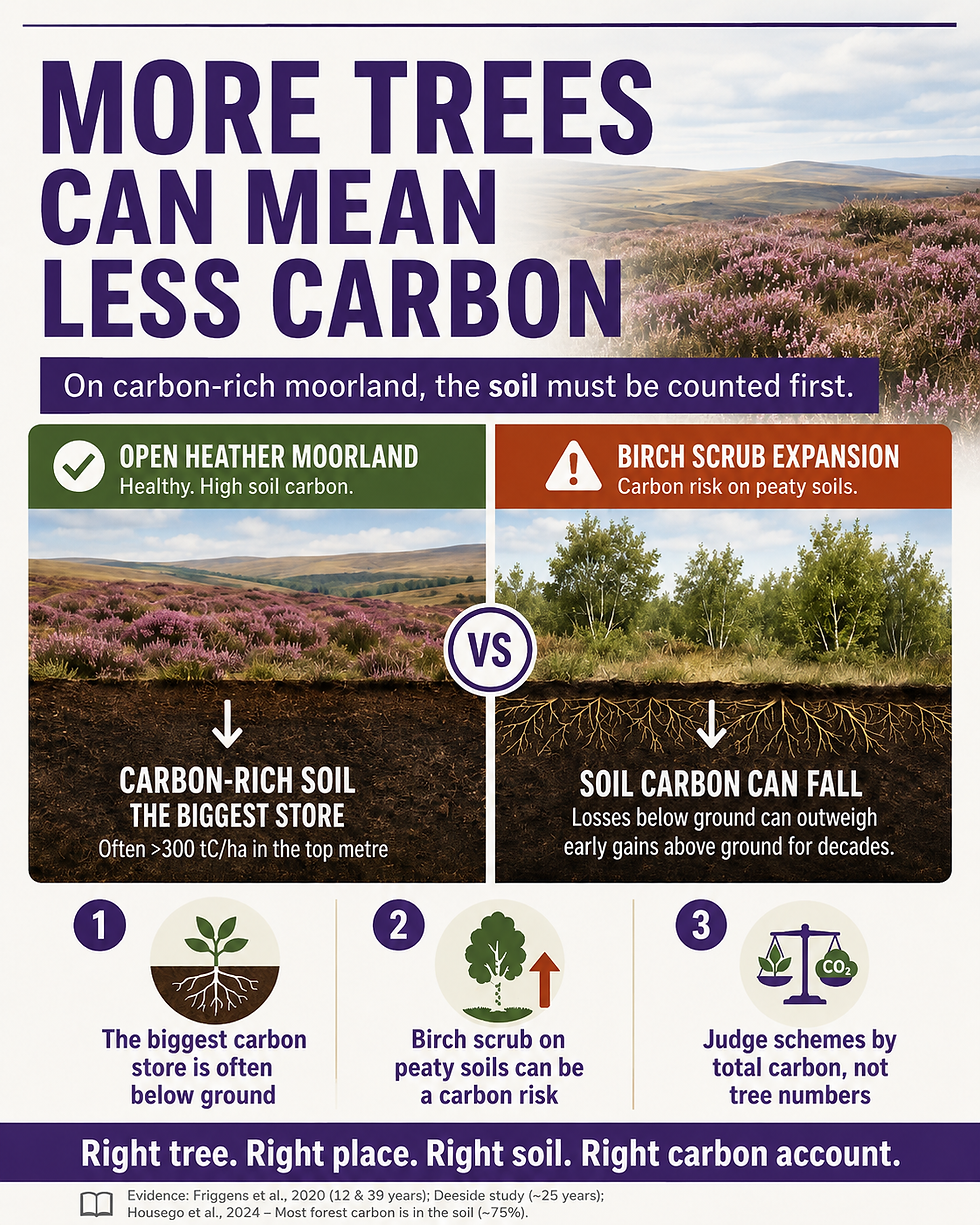
The biggest carbon store on a heather moor is not the heather. It is the peaty soil beneath it.
That matters because a growing policy assumption says upland moorland should be allowed to scrub over or be planted with trees. On the wrong soils, that can backfire.
Trees store carbon above ground, but carbon-rich upland soils can lose carbon when woodland establishes. On some moorland soils, the loss below ground can outweigh the gain above ground for decades.
This is not an anti-tree argument. It is a right-tree, right-place argument. MA members need to insist that any woodland or rewilding proposal starts by counting the carbon already stored in the soil.
What this means for MA members
1. Do not let woodland carbon claims ignore soil carbon. The climate test is not how many trees are established. It is whether total carbon (soil plus vegetation) is protected and increased.
2. Birch regeneration on peaty podzols, peaty gleys and other organo-mineral soils may reduce total carbon for decades. On carbon-rich moorland soils, naturally regenerating birch should not be assumed to be climate-positive.
3. Natural regeneration is not automatically carbon-positive. Avoiding ploughing and drainage reduces disturbance, but the evidence shows soil carbon can still fall when trees establish on organo-mineral soils.
4. Woodland belongs on the right ground. Woodland creation can be positive on lower-carbon mineral soils, degraded sites, shelterbelts and places where soil carbon risk is low. But avoiding deep peat is not enough: shallow peat and organo-mineral soils also need a proper carbon test. The MA is not anti-tree; it is anti-bad-carbon-accounting.
5. Moorland management has a climate role. Keeping carbon-rich soils wet, vegetated, open and protected from severe wildfire is part of responsible carbon management.
Why soil carbon must come first
The first question in any moorland tree proposal should not be “how many trees?”, but “how much carbon is already in the soil?”
Trees store carbon above ground as they grow, but on heather moorland the largest and most vulnerable carbon store is often below ground, in peat and organo-mineral soils. If that existing store is not counted, a planting or rewilding scheme can look like a climate gain while actually risking a carbon loss.
Across British forests as a whole, most forest carbon is in the soil, which contains about three-quarters of forest carbon stocks (Housego et al., 2024). Moorland works in the same way.
The visible vegetation matters, but the bigger climate store is the dark, peaty ground underneath. That is why a carbon account that counts stems, trunks and canopy, but gives only passing attention to soil, can give the wrong answer.
That matters especially on heather moorland, where peat and organo-mineral soils are the main carbon store. Organo-mineral soils are the shallow peaty soils over mineral ground, including peaty podzols and peaty gleys, that sit under much upland moorland.
They may not look like deep peat, but they can still hold very large carbon stocks: more than 300 tonnes of carbon per hectare in the top metre, around two-thirds of what deep peat holds and about three times the carbon found in arable land.
Scotland’s soils store around 3,000 million tonnes of carbon, so a loss of just 0.34% a year would roughly double the country’s greenhouse gas emissions (Housego et al., 2024).
It is now widely accepted that new woodland should not be planted on deep peat. But MA members should not let the argument stop there. Shallow peat and organo-mineral soils (the peaty podzols, peaty gleys and humus-rich soils common on many moors) can also hold large carbon stocks.
They may fall below the deep-peat threshold, but they are not low-carbon soils. Planting or allowing scrub to establish on them can still be a real carbon risk.
The practical point for MA members is simple: no woodland or rewilding claim should be accepted unless it counts soil carbon first. A proposal that looks good when judged by trees and hectares may look very different when judged by total carbon.
This should include soil, vegetation, wildfire risk and the timeframe. On carbon-rich moorland, the carbon already in the ground is not a footnote; it is the starting point. As Housego et al. put it: “carbon-rich soils typically lose carbon under forestry, while carbon-poor soils typically gain.”
The clearest example of this risk is birch scrub on carbon-rich moorland soils.
Why birch scrub can be a carbon risk
Birch scrub is often presented as natural recovery, but on carbon-rich moorland soils it can be a carbon risk. The issue is not whether birch is native, attractive or valuable for wildlife in the right place.
The issue is whether birch on peaty podzols, peaty gleys and other organo-mineral soils causes more carbon to be lost from the soil than the young trees store. On this ground, “natural” scrub expansion should not automatically be treated as a climate gain.
The evidence matters because it measures what happens on the ground, rather than simply modelling what might happen. Scientists compared birch woodland on organo-mineral soils in north-east Scotland with neighbouring heather moorland.
After 12 years, and again after 39 years, the birch soils held less carbon than the moorland soils. Their conclusion was blunt: “Tree planting in organic soils does not result in net carbon sequestration” (Friggens et al., 2020).
The same pattern appeared in Deeside, where soil carbon under heather moorland was around 50% higher than under neighbouring naturally regenerated birch and Scots pine. Those trees had seeded in naturally over roughly 25 years, yet the carbon-rich organic layer under the trees was about half as thick as under the open moor.
That makes the Deeside evidence especially relevant to rewilding and scrub expansion claims, because it shows that soil carbon loss can occur even without ploughing or formal planting (Housego et al., 2024).
This does not mean every tree species behaves in the same way. In the Friggens study, the Scots pine plots did not lose soil carbon in the same way as the birch plots, apparently because pine needle litter builds up slowly on the forest floor while birch leaf litter breaks down more quickly.
Housego et al. also note that tree roots and woodland fungi can alter soil processes in ways that may speed carbon breakdown. Species matters, but it does not remove the need to test the soil-carbon balance.
The safer conclusion is narrower but important: on carbon-rich moorland soils, birch cannot be assumed to be carbon-neutral or carbon-positive. In the right place, birch scrub may have biodiversity, shelter or landscape value.
On organo-mineral moorland soils, however, it may also carry a carbon cost. MA members should therefore challenge any proposal that presents birch regeneration as an automatic climate benefit without first showing the likely effect on soil carbon.
Why natural regeneration is not a free pass
Some commentators suggest that natural regeneration avoids this problem because there is no ploughing, draining or planting disturbance. Lower-disturbance woodland establishment should reduce some of the immediate risks to soil carbon but it does not prove that the resulting woodland is carbon-positive.
However the scientific evidence does not show that natural regeneration is automatically carbon-positive on organo-mineral soils.
Housego et al. describe the long-term impacts of regenerating trees on these soils as unclear, and the Deeside evidence points to a real risk: soil carbon stocks under heather moorland were about 50% higher than under adjacent sparse 25-year-old Scots pine and birch regeneration (Housego et al., 2024).
The measurements are important because the trees had seeded naturally, yet the soil carbon under them was still lower than under open heather moorland. The organic horizon under the trees was about half that of the open moor, and soil carbon in the top 10cm of the mineral horizon was similar, suggesting that the missing carbon had not simply moved deeper into the soil profile.
For MA members, the message is that “natural” does not necessarily mean “better for carbon”. Natural regeneration may be the right answer on some lower-carbon soils and in some landscape contexts, but on carbon-rich moorland it still needs a proper carbon account.
The test should be the total carbon balance over time, not whether the trees arrived by planting or by seed.
This is why tree targets based only on hectares can mislead.
Why area-based tree targets can mislead
The problem with many woodland targets is that they count hectares, not carbon. A target to “establish X hectares of woodland” sounds precise, but hectares are not carbon. It does not tell us whether the scheme will increase total carbon once soil, vegetation and time are included.
On carbon-rich moorland, that omission matters because the soil carbon already present may be larger and more vulnerable than the carbon the young trees will store.
Scientists modelled afforestation across Scotland and found that the same woodland type can produce very different carbon outcomes depending on where it is put. Their work shows that climate benefit depends on soil type, previous land use, tree species and management regime, not simply on the number of hectares planted.
They warn that extensive establishment of lower-yielding trees on low-quality ground with organo-mineral soils can result in “net emissions that persist for decades” (Matthews et al., 2020).
On lower-carbon mineral soils, woodland can begin banking carbon much sooner. These are the places where tree growth is less likely to be offset by large soil carbon losses, and where woodland creation can make stronger climate sense. That is why the argument is not against trees, but against putting trees where the carbon account does not work.
On carbon-rich semi-natural ground and organo-mineral soils, the early soil losses can outweigh tree growth for decades. This is exactly the risk MA members need to watch for in woodland creation, rewilding or natural regeneration proposals on moorland.
A scheme may look good in photographs, maps and headline hectare figures, while still being a poor carbon decision if the soil losses are ignored.
Valette and colleagues reached the same basic conclusion in the Cairngorms: woodland expansion on carbon-rich soils still showed net emissions after 40 years, while expansion on carbon-poor soils performed better.
Their modelling also showed that woodland expansion creates trade-offs between carbon storage, biodiversity, red grouse habitat and existing moorland management. In other words, tree expansion is not a simple climate win; it depends where it happens and what it replaces (Valette et al., 2024).
That is why “X hectares of new woodland” is not a climate policy unless it is backed by a total carbon test. The better question is not how much land has changed colour on a map, but whether the whole system is storing more carbon after 20, 40 or 100 years.
For MA members, the challenge is to insist that any woodland proposal on carbon-rich moorland proves its carbon case before it is treated as a climate gain.
Where woodland does make sense
None of this is an argument against woodland. Trees and scrub have an important place in the uplands, and woodland creation can deliver carbon, biodiversity, shelter, landscape and water benefits when it is put on the right ground.
The evidence does not say “no trees”; it says that woodland carbon claims must be judged against soil type and total carbon balance.
Woodland creation can be a climate gain on lower-carbon mineral soils, degraded ground, shelterbelts, riparian corridors and sites where soil carbon risk is low.
Housego et al. make the distinction clearly: carbon-rich soils typically lose carbon under forestry, while carbon-poor soils typically gain carbon (Housego et al., 2024). That is the basis of the right-tree, right-place argument.
The right policy is not fewer trees everywhere, but better targeting. Matthews and colleagues show that more productive land classes can deliver more net sequestration per hectare, while lower-yielding trees on low-quality ground with organo-mineral soils can create net emissions for decades (Matthews et al., 2020).
That points policy towards places where trees genuinely add carbon, rather than places where they risk disturbing carbon already safely stored in the soil.
For MA members, this distinction matters because it keeps the argument evidence-led rather than defensive. A member can support woodland in the right place while opposing woodland or scrub expansion on carbon-rich moorland where the carbon account does not work. That is a stronger position than appearing simply resistant to change.
The test should be: right tree, right place, right soil, right carbon account. If a woodland proposal increases total carbon, protects soil, reduces wildfire risk and fits the landscape, it deserves consideration. If it counts only trees and hectares while ignoring soil carbon, it should not be presented as a climate solution.
Why working moorland matters
The carbon in heather moorland does not sit in a wilderness; it sits in a managed landscape.
For generations, grazing, cutting and controlled burning have helped shape open moorland habitats. On carbon-rich soils, that management can matter for climate as well as wildlife, because keeping the ground vegetated, open and functioning helps protect the carbon already stored below.
Well-managed grazing, cutting and controlled burning can help keep moorland open and reduce unmanaged scrub expansion on carbon-rich soils. That matters where the likely successor is birch scrub on peaty podzols, peaty gleys or other organo-mineral soils.
The evidence above does not say that every tree is bad, but it does show that allowing carbon-rich moorland to scrub over cannot simply be assumed to increase carbon.
There is also a wildfire dimension, because severe wildfire on dry carbon-rich ground can burn into the soil itself.
Valette and colleagues note that future land-use scenarios may increase the overlap between carbon-rich soils and biomass at risk of wildfire, potentially leading to soil combustion and associated carbon emissions (Valette et al., 2024). On moorland, fuel load and fire severity are therefore part of the carbon account, not a separate issue.
This is not a licence for careless burning, but it does challenge the idea that all managed fire is bad for carbon. Valette et al. cite analysis showing that 96% of Scottish wildfires between 2015 and 2020 occurred outside areas managed with prescribed fire for red grouse, while also noting that uncertainties remain about how prescribed fire patterns affect wildfire risk (Valette et al., 2024).
For MA members, the key point is that active moorland management has a climate role when it keeps carbon-rich soils vegetated, open, wet where possible, and protected from severe wildfire.
The case is not that every management practice is automatically beneficial. The case is that abandonment, scrub expansion and unmanaged fuel build-up can also carry carbon risks and those risks must be counted.
The burden of proof should therefore sit with those proposing change, not with those already managing land that is holding large soil carbon stocks.
Before a planting scheme, natural regeneration plan or rewilding proposal is presented as a climate gain, it should show the full carbon balance: soil carbon, vegetation carbon, timescale, species, disturbance and wildfire risk.
For MA members, the message is simple: do not judge a climate scheme by the number of trees; judge it by whether total carbon is protected and increased.


