
Why Grass and Heather Moors Burn Differently

Updated: 3 days ago
Quick summary
Vegetation type is the strongest driver of wildfire size, severity and timing across England and Wales.
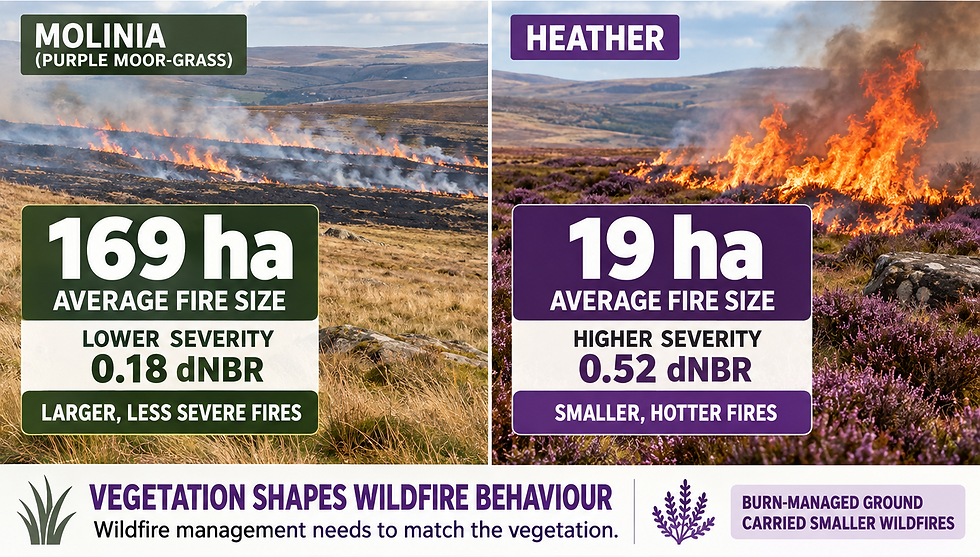
Molinia grass moors produce the largest fires, averaging 169 hectares, but the least severe damage.
Heather burns hotter and smaller, peaking in severity at 0.52 dNBR against Molinia's 0.18.
Burn-managed ground carried smaller wildfires; peatland restoration showed no measurable fire-reduction effect here.
The findings
Vegetation type is the strongest signal in how open-country wildfires behave. A study of 206 wildfires across England and Wales, the largest satellite record of its kind for these countries, shows that grass moors and heather moors burn in almost opposite ways, and that ground managed by burning holds fires to a smaller size.
Molinia (purple moor-grass) ground produces the largest fires but among the least severe. Heather and other shrub-dominated ground produces smaller fires that burn far hotter.
Wildfires on burn-managed ground were smaller than on unmanaged ground, which the study links to lower fuel loads and the firebreaks left by past burning. Peatland restoration was not shown to reduce fire size or severity.
Grass burns big, heather burns hot
The contrast between grass and shrub was sharp. Molinia fires were 45% of all fires recorded but around 67% of the total area burned. The average Molinia fire covered about 169 hectares, against 19 for heather and 33 for heathland. Molinia ground also burned far more often: 5.8% of it each year, against 0.03% of heather ground and 0.13% of other open land.
These large grass fires did the least damage, and timing explains why. Molinia fires strike in early spring, around April, when last season's grass has died back and dries quickly. The fire runs through dead surface material rather than living, woody stems.
Heather burns the other way. Being woodier, it ignites hotter. The study rated burn severity from satellite imagery using the differenced Normalised Burn Ratio (dNBR), and, for the first time in UK landscapes, checked those ratings against ground surveys of fire damage.
On that scale Molinia fires averaged 0.18, in the low band, while heather fires reached 0.52, the highest of any vegetation. Heathland and mixed moorland fell between the two.
When each type burns
Fire seasons split by vegetation as well. Molinia ground showed a single spring peak. Heather showed two: an early one around February, when the plant is dry and most ignitable, and a second in spring.
Heathland burned latest of all. These sites tend to sit closer to towns, and the study points to higher visitor numbers in holiday periods as a likely driver, since nearly all UK wildfires are started by people.
What it means on the ground
Fire planning should be guided by the vegetation rather than using a one-size-fits-all approach. On Molinia country such as Dartmoor, Exmoor, Bodmin Moor and much of Wales, the threat is large, fast spring fires driven by dead grass.
Reducing that spring fuel load, and cutting the accidental and deliberate ignitions where fires recur in the same places year after year, is where the study points effort. Molinia is spreading, linked in the research to nitrogen deposition, so these large early-season fires are likely to become more common.
On heather country such as the North York Moors, the issue is heat, not size. Here the study found burn-managed ground carried smaller wildfires than unmanaged ground, and puts this down to reduced fuel and firebreaks. That supports a long-held case for managed burning as a wildfire control.
The study did not find that peatland restoration reduced fire size or severity. That result carries weight in a debate where rewetting and restoration are often promoted as fire prevention.
For upland managers the conclusion to draw is: know your dominant vegetation and match the plan to it. Grass moors need the spring fuel load and the ignitions tackled. Heather moors need the tools that keep fires small, managed burning among them.
Key Takeaway
Vegetation type sets how uplands burn: grass moors burn large but light, heather burns hot, and ground managed by burning carries smaller wildfires.


