WMO Finds Wildfire Smoke Is More Toxic Than Its Particle Count Suggests


The societal impacts of aerosol–cloud interactions emerge from changes in radiation balance and in global precipitation patterns (CERTAINTY project).
Quick summary
Wildfire smoke is more toxic, particle for particle, than pollution from traffic and industry.
Standard risk models may undercount deaths from fire events by up to 93%.
Extreme fire-smoke events have tripled worldwide since the 1990s, the World Meteorological Organization (WMO) reports.
Smoke from wildfires is more toxic, particle for particle, than the fine pollution produced by traffic and industry. The risk models used to estimate deaths from air pollution do not account for that difference. A European study covering 654 regions found the shortfall could reach 93% when those models are applied to fire events.
The finding features in the sixth World Meteorological Organization (WMO) Air Quality and Climate Bulletin, published this September.
The same document reports that extreme fire-smoke events have tripled around the world since the 1990s, and that exposure to fire-derived PM2.5 (particulate matter under 2.5 micrometres across, fine enough to pass from the lungs into the bloodstream) has risen across the globe.
Taken together, the two claims say the health cost of wildfire has been climbing whilst being undercounted.
What makes wildfire smoke different
Inhaled wildfire smoke sets off inflammation through the body and oxidative stress, a chemical imbalance in the cells that leaves the lungs less able to clear out foreign particles.
The WMO cites reviews and experimental work linking exposure to asthma attacks, hospital admissions for chronic obstructive pulmonary disease, higher use of respiratory medication, and effects on mental health and on birth outcomes.
Where fires reach buildings, burning synthetic material adds pollutants that vegetation smoke does not contain.
Conventional risk models were based on total particle mass. They count a microgram of smoke and a microgram of exhaust as the same thing. The bulletin's authors say that is where the undercount comes from.
How big the global burden is
Acute exposure to wildfire-derived particles was estimated to contribute around 99,000 additional deaths a year worldwide between 2010 and 2018. Across the same years there were some 12 billion person-days of exposure above the World Health Organization daily limit of 15 micrograms per cubic metre. Wildfire smoke accounted for at least half of that excess.
Sub-Saharan Africa carries 28% of global deaths from fire smoke and eastern Europe 24%. The trend bearing most directly on Britain is a different one. Across Europe and North America total PM2.5 has fallen as vehicles and industry have been regulated, while the share coming from wildfire has grown.
The 2025 picture
Four modelling systems mapped global PM2.5 for 2025 against a baseline running from 2003. Three of them include satellite readings of aerosol, the mixture of fine particles and droplets held in the air. The fourth works from emissions and weather alone. The four broadly agree, which the WMO treats as a sign that the atmospheric physics behind them is well understood.
All four show raised concentrations across northern Canada and around Lake Baikal, both attributed to wildfire. The three satellite-based models also register a hotspot in north-western Spain, linked to exceptional biomass burning in late summer 2025.
Crucially, smoke does not stay where it is made. European monitoring tracked the plume from the Canadian fires of summer 2025 high over the continent, then at Mediterranean sites, with deposition recorded afterwards at high-altitude stations.
What it means for the uplands
The Moorland Association maintains that managing fuel loads, including controlled burning where conditions and consents allow, is essential for reducing wildfire risk. The harm caused by wildfire is far greater than current figures record.
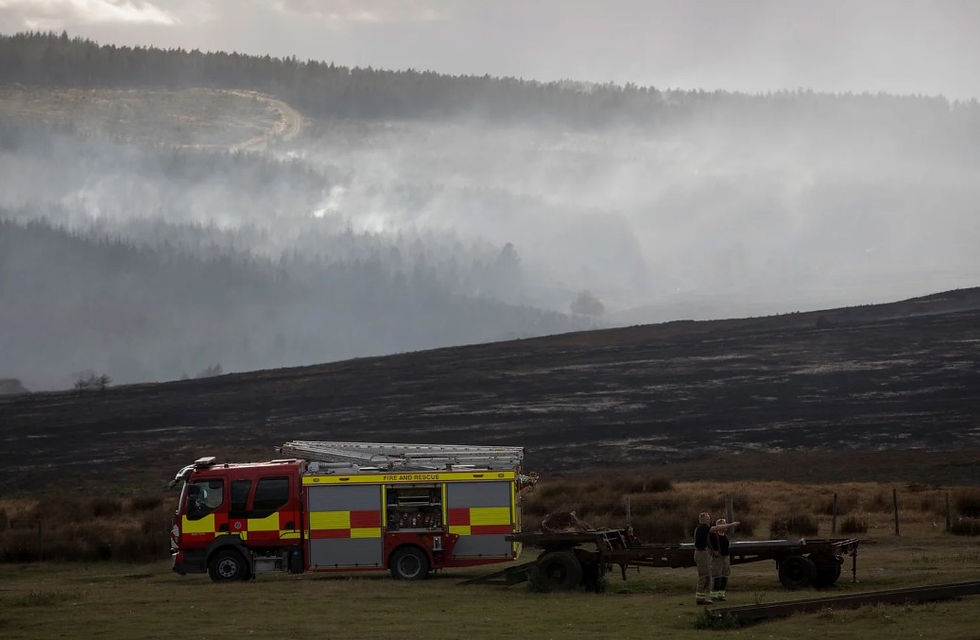
Wildfire in the uplands is argued over in terms of habitat, peat and carbon. The WMO's evidence adds another dimension: public health.