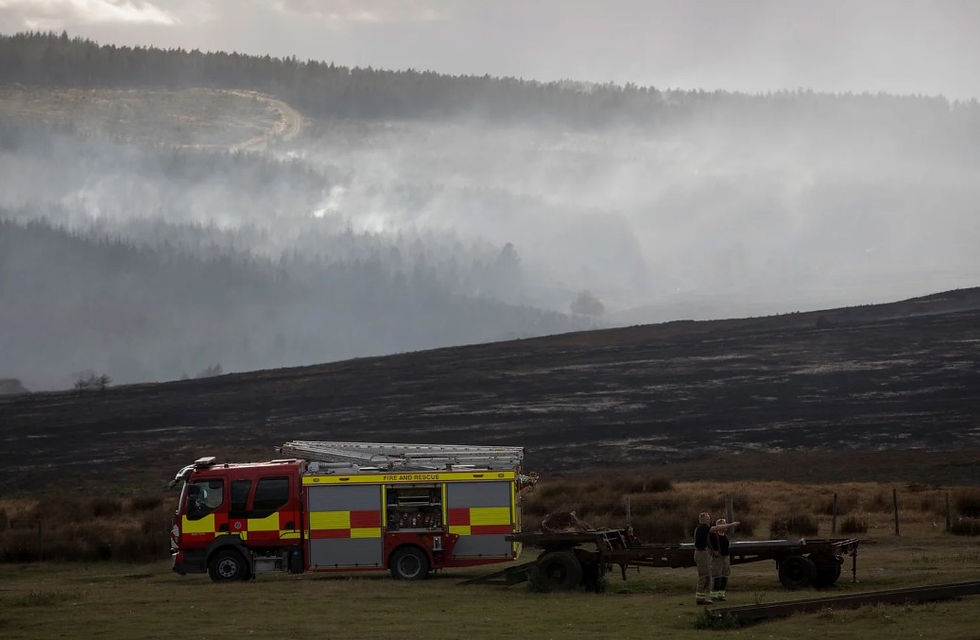
A Bog in Fifty Years, More Fuel Next Spring


Quick summary
Defra concedes that peatland in transition may still need flammable vegetation removed, including by licensed burning.
Blanket bog recovery runs to decades or centuries, so the transition period is long, not brief.
Rewetting leaves continuous fuel across the surface; Peak District modelling puts flame lengths beyond fire service control.
Restoration results in an early carbon cost, and no one is managing surface fuel during the gap.
When it presented the 2025 controlled burning rules before Parliament, Defra accepted something worth noting. Restoring peatland to a naturally wet state takes time, the department said, and during that transition flammable vegetation may still need to be removed, including by burning under a licence, where other methods are not feasible.
That is the transition-risk case, conceded on the record by the department that wrote the restrictions on using controlled burning to reduce fuel loads.
The Moorland Association does not dispute the long-run case for rewetting. Wet peat holds carbon, and a functioning bog is harder to burn. Our members block grips and they plant Sphagnum. The question is: what happens during the forty or fifty years in between, and who is expected to deal with it.
Recovery can take decades
Blanket bog does not switch state when the grips are blocked. Work published in Ecological Applications in 2025 followed a stretch of blanket bog in northern Scotland that had once been planted with conifers. It found that the plants growing there may take decades, and possibly centuries, to look like the plants on a bog that was never damaged.
Monitoring in the Flow Country tells the same story from a different angle: after 14 years, moisture conditions had recovered, but full vegetation recovery had happened only in the wetter areas of the bog and not on the drier patches.
Evans and colleagues went further. They found blanket bogs less responsive to drainage or rewetting than other peatland types, with infilling of lost peat and recovery of original carbon stocks likely to take longer than is generally anticipated.
None of this is a case against restoration. But it does raise questions over how long restoration takes, and about what happens while we wait.
The fuel does not wait for the water table
Rewetting raises the water table long before it changes what grows on top. Until the vegetation catches up, the moor still holds whatever the last round of management left there — and where management has stopped altogether, that load grows every year.
Ashby and Heinemeyer, writing in Wetlands in 2021, explain how this works. Where burning stops, heather grows to much the same age and height over wide areas, instead of the patchwork of young and old stands that managed moorland features.
That leaves more fuel, spread evenly, so a wildfire that does start burns hotter. What follows is well established in the research: more fuel means more heat, a fire that lasts longer, and a greater chance the peat itself catches.
Modelling in the Peak District put figures on it. Under unmanaged fuel loads the work found potential flame lengths of up to 7.6 metres and rates of spread of 2,393 metres an hour, beyond the capacity of the fire and rescue service to control.
For scale, US Forest Service fire behaviour guidance treats flame lengths beyond roughly 1.2 metres as the point where hand crews can no longer attack a fire at the head.
A bog that is properly wet is hard to set alight. A bog part-way through the long job of being rewetted is not, and when it does catch, it is often serious.
Restoration releases carbon before it starts saving any
A controlled rewetting experiment in south-eastern Norway, published in Scientific Reports in 2025, measured the carbon cost of restoration directly. Before the work started, the site was giving off about 12.2g of carbon as CO2 for every square metre each year.
In the first year after rewetting that jumped to 53.3g, and in the second year it was 41.2g. By comparing the site with how it would have behaved had it been left alone, the researchers put 80.3g per square metre of extra carbon down to the rewetting itself.
The cause was disturbance: trees felled, low vegetation stripped from the ditches, and peat excavated to fill them, which reduced plant uptake and raised the rate of organic matter mineralisation.
The gap nobody is managing
Since 30 September 2025, burning on peat deeper than 30cm inside a Less Favoured Area in England has required a Defra licence. That brought the area under burning constraints to 676,628 hectares of deep peat.
Parliament has noticed the problems this has caused. The EFRA Committee's wildfire inquiry drew 190 submissions, close to 70 per cent of them from individual land managers, and its chair wrote to the Secretary of State on 7 July 2026 asking how the department is addressing concerns about obtaining managed burning licences, and how far Natural England's evidence review informed the 2025 rules.
A strong theme throughout the evidence, the letter said, was apprehension about the increasing likelihood and severity of wildfires because of vegetation build-up.
Those submissions came straight from the people who are on the land when it ignites.
Why this matters
Defra has already accepted in writing that the transition years need flammable vegetation removed, including by controlled burning.
Our moors are living through those years now, which is why the MA will keep pressing for surface fuel management to be treated as part of restoration rather than as its opposite.