Defra Cites Reduced Predator Control as Moorland Bird Numbers Fall


Quick summary
Defra figures show UK upland breeding birds fell 19% between 1994 and 2025, and 15% in England.
Upland specialists fared worst, falling 39% in England since 1994 and 20% in the last five years.
Defra cites reduced predator control as a major pressure on moorland birds; reduced persecution has helped raptors recover.
Research shows legal predator control helps ground-nesting birds such as golden plover and curlew raise more young.
Defra’s latest accredited official statistics, Wild bird populations in the UK and England, 1970 to 2025, were published on 13 October 2026. The upland chapter shows that breeding upland birds fell by 19% in the UK and 15% in England between 1994 and 2025.
The losses fall hardest on upland specialists, the species most closely tied to open moorland. In England they fell by 39% over the period, and by 20% in the last five years.
What Defra says about the pressures on upland birds
Alongside the trends, the report summarises what reviews of the evidence have found about causes. Two statements relate directly to moorland management.
Reductions in site-based predator control are one of the major pressures on open-nesting moorland species.
Reduced persecution has contributed to the recovery of several raptor species.
Specialists and generalists
Defra divides upland birds into specialists and generalists. Specialists are strongly associated with open moorland. Generalists are widespread and also use farmland, woodland and other habitats.
Index | Country | Species | 1994–2025 | 2020–2025 |
All | UK | 32 | -18.8%* | -6.4%* |
All | England | 28 | -15.1%* | -7.2%* |
Specialists | UK | 15 | -32.7%* | -14.6%* |
Specialists | England | 12 | -39.3%* | -20.2%* |
Generalists | UK | 13 | -1.6% | +4% |
Generalists | England | 12 | +21.1%* | +7.7% |
*Statistically significant. Smoothed trends. Source: Defra, Table 6.
Specialists declined significantly in both countries and over both periods. Generalists rose by 21% in England since 1994 and showed little change across the UK.
Species named by Defra
In the UK, red kite numbers have risen by more than 600% since 1994 and stonechat by more than 300%. Both are upland generalists and still increasing.
Peregrine and redshank, also generalists, have more than halved. Among the specialists, dotterel, whinchat and red grouse have declined.
In England, whinchat and twite show strong long-term declines, while red grouse, raven, lapwing and golden plover have declined markedly in the short term. Common sandpiper has declined over the long term in both the UK and England, and grey wagtail and dipper show recent declines.
Research on managed and formerly managed moors
The studies below show an interesting contrast with Defra’s latest figures.
Comparison of 122 estates, eastern Scotland and northern England. Tharme et al. (2001) recorded golden plover and lapwing at five times the density, and red grouse and curlew at twice the density, on grouse moors compared with other heather moorland. Meadow pipit, skylark and whinchat were less abundant there. The authors describe their evidence as correlative.
Predator Control Experiment, Otterburn, Northumberland. Over eight years, reducing foxes and crows tripled breeding success, on average, for lapwing, golden plover, curlew, red grouse and meadow pipit (Fletcher et al., 2010). With predator control, breeding numbers of the waders and red grouse rose by at least 14% a year; without it, they fell by at least 17% a year.
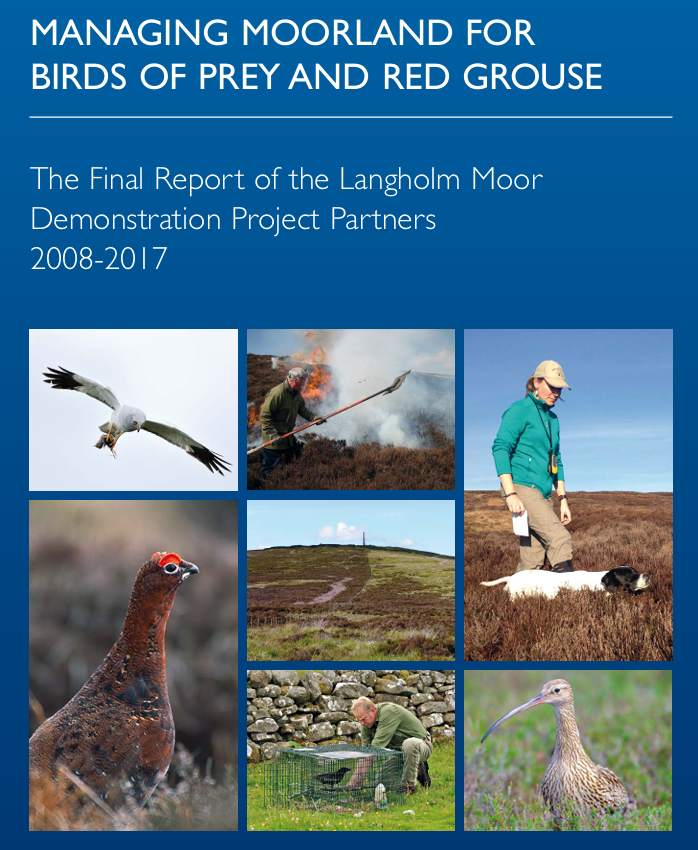
Before and after, Langholm, south-west Scotland. When grouse management stopped in 2000, golden plover, lapwing, curlew and red grouse declined while carrion crow and snipe increased. The authors suggest rising crow and fox numbers probably contributed (Baines et al., 2008). After management resumed in 2008, curlew rose by an average of 10% a year and golden plover by 16% to 2017, but lapwing numbers did not change (Ludwig et al., 2019).
Repeat surveys, Berwyn, north Wales. As grouse management declined, lapwing were lost between 1983–85 and 2002, golden plover fell by 90% and curlew by 79%. Meadow pipit, whinchat and stonechat increased (Warren and Baines, 2014).
Resurveys of curlew sites, UK uplands. In a study by RSPB scientists, curlew population change was positively associated with gamekeeper density and negatively with nearby woodland (Douglas et al., 2014). Their models suggest that where woodland covers 10% of the land within 1 km, curlew numbers would only hold steady with predator control about 48% higher, at a level associated with intensive grouse moor management.
Implications for upland bird policy
At Otterburn, legal predator control raised breeding success, and the authors recommended that some of the public money spent on habitat improvement should fund predator control. The curlew study suggests that forest expansion near open moorland, another of Defra’s pressures, raises the level of predator control needed.
Defra names the loss of predator control as a major pressure on moorland birds, and the site studies support it. If upland specialists such as curlew and golden plover are to recover, legal predator control needs to sit alongside habitat work in upland policy.