
Grouse Moor Management in Numbers
- Rob Beeson

- Apr 28
- 3 min read
The Environment
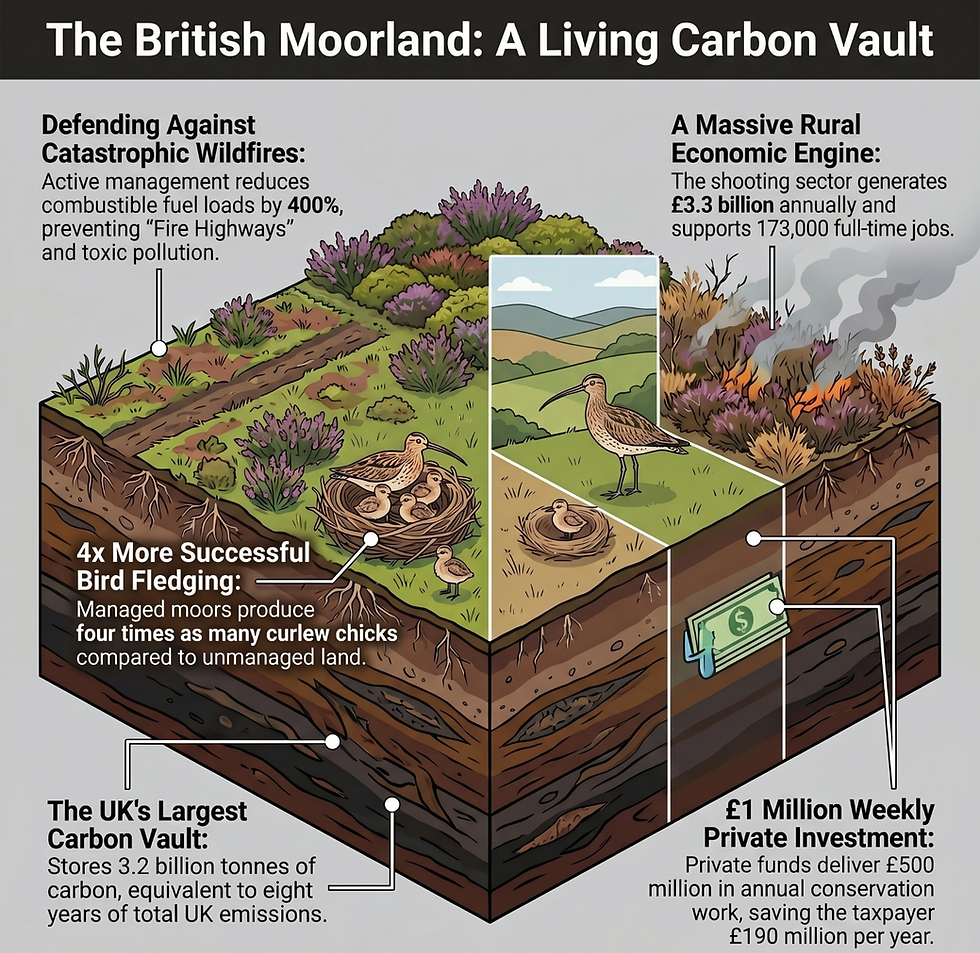
3.2 Billion Tonnes: The amount of carbon safely locked away in UK peatlands. Our peatlands are the nation's largest carbon vault, storing the equivalent of up to eight years of the UK's total emissions. Developing wind farms on deep peat risks disturbing this fragile, irreplaceable carbon sink.
860,000 Acres: The vast scale of high-value upland habitat actively conserved by moorland managers.
Britain is home to a large proportion of Europe’s remaining heather moorland. This isn't just empty space waiting to be built on; it is a globally rare landscape.
4x More Successful: Curlew pairs on managed grouse moors raise four times as many chicks (1.05 fledglings per pair) compared to unmanaged land (0.27 per pair).
Gamekeepers protect 53% of the English curlew population. Without our predator control, replacing these lost birds using taxpayer-funded conservation models would cost between £5,000 and £10,000 per fledged chick.
80% of Nests: The proportion of successful hen harrier nests located on driven grouse moors. Despite managing only half the suitable habitat, our on-the-ground efforts have helped drive a staggering 1,150% increase in English hen harrier numbers since 2016, hitting a 200-year high.
The Rural Economy
£1 Million Every Week: The amount of private investment injected directly into managing grouse moors.
Private money is supporting local supply chains, yielding a knock-on benefit of £12 million annually for rural businesses.
£3.3 Billion (GVA): The annual value of the shooting sector to the UK economy, generating a massive £9.3 billion in wider economic activity.
This is a localized economic engine that keeps the village pub open, supports local mechanics, and provides sustainable, healthy food (with 95% of shot game entering the food chain).
173,000 Jobs: The number of full-time equivalent jobs supported nationwide by shooting and its associated voluntary work.
These are permanent, deep-rooted rural livelihoods, not temporary construction contracts.
£190 Million per Year: The estimated cost to the taxpayer if driven grouse shooting were scrapped and the state had to fund the conservation work themselves.
Shooting delivers £500 million worth of conservation work annually - effectively 14 million workdays - completely free of charge to the public purse.
Protectors of the Moor - Gamekeepers & Wildfire
£460 Million: The staggering cost of UK wildfires in 2025 alone, with a record-breaking 46,000 hectares burned.
Neglecting traditional fuel management causes catastrophic financial and ecological damage. Wildfires don't just destroy nature; they threaten local infrastructure, power lines, and turbines.
40,000 Tonnes of CO2: The amount of carbon released into the atmosphere during the 2018 Saddleworth Moor wildfire alone.
A single unmanaged wildfire can wipe out years of carbon savings generated by renewable energy projects.
400% Increase in Fuel Load: Without active management (like controlled burning), combustible dead vegetation jumps from a safe 2–4 tonnes per hectare to a highly dangerous 10–15 tonnes per hectare in just two decades.
Gamekeepers actively create firebreaks and reduce this fuel load. Without us, the moors become a "Fire Highway."
95% Methane Reduction: The emissions cut achieved by carefully cool-burning the surface of degraded peat before rewetting it, over a 90-day period.
Controlled burning is a highly skilled, science-backed tool that protects the soil and captures carbon, preventing the deep-peat fires that require massive emergency service deployments.
5 Million People Exposed: The number of people subjected to dangerous, toxic pollution (including historic lead and cadmium) during the Saddleworth fire.
Wen a fire breaks out in remote terrain, it is the gamekeepers with their local knowledge, ATVs, and fogging units who are first on the scene, preventing public health disasters at zero cost to the emergency services.
Don't Miss the Latest Moorland News
Get news of policy shifts, new research and land management changes that affect upland Britain, delivered free every week. If it matters on the moor, you'll hear it from us first.


