Why Reforming Wildfire Monitoring is the Key to Protecting Our Uplands
- Rob Beeson

- May 8
- 3 min read

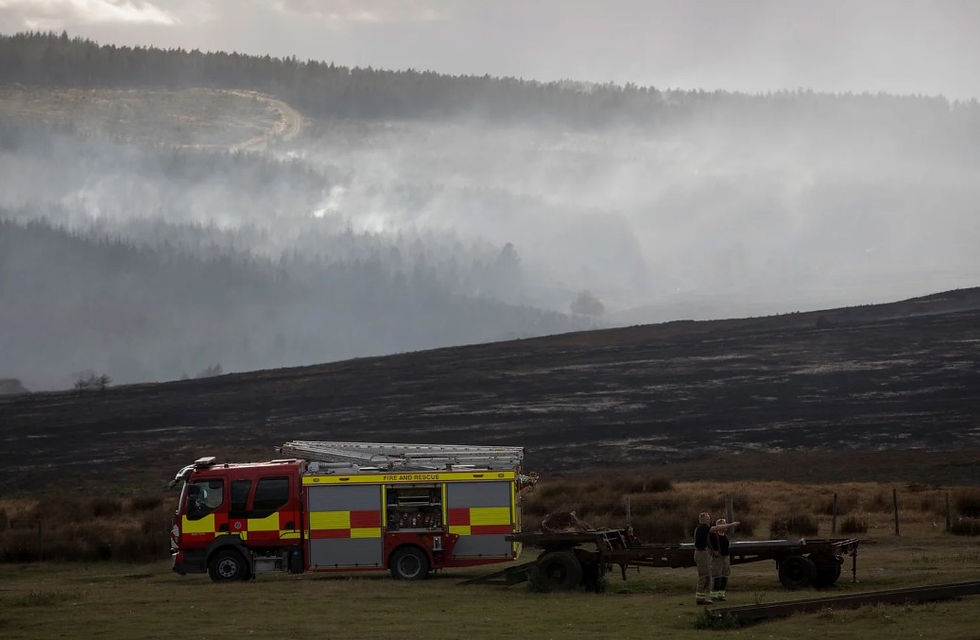
In 2025, the UK witnessed the devastating reality of a changing climate meeting unmanaged landscapes. Over 46,000 hectares of land burned in record-breaking wildfires, costing the nation a staggering £460 million and releasing 1.3 million tonnes of carbon emissions. The scale of this destruction has triggered an urgent national conversation.
The Government's EFRA Committee has rightly asked: What impact does the monitoring of wildfires have on our understanding of the causes and risks of these events in the UK, and how can this be improved? Are there international examples or best practices that can be used in a UK context?
For the Moorland Association, the answer is clear. To prevent future disasters, we must overhaul what we monitor, who we listen to, and how we learn from the rest of the world.
The Blind Spot: Current Monitoring Shortfalls
If we only monitor wildfires after they ignite, we have already lost the battle. Currently, our national monitoring systems focus heavily on weather patterns and ignition sources, but they often overlook the fundamental mechanics of fire risk.
The true driver of catastrophic wildfires is the accumulation of unmanaged vegetation. When moorlands are left unmanaged, older heather and grasses die off, creating a thick, woody carpet.
Recent groundbreaking research tracking the moisture of heather hour-by-hour highlights a fatal flaw in how we currently assess risk. The study revealed that daily moisture changes in unmanaged heather are dramatic and rapid.
Vegetation that appears perfectly safe and damp at breakfast can become completely dried out and primed to explode into flames by lunchtime. Because current monitoring models struggle to account for these rapid diurnal shifts in shrub-type fuels, the afternoon fire risk on our moorlands is frequently - and dangerously - underestimated.
Improving Our Understanding: Better Data and Local Knowledge
Improving our understanding of wildfire risks requires two immediate changes: adopting accurate data and trusting local expertise.
First, we must demand honesty in our statistics. For too long, policy debates have been skewed by misinformation. A prime example is the claim that "68% of wildfires in the English uplands are caused by managed burning." This figure is entirely false and misrepresents the underlying data.
The reality, in line with normal international standards, is that only 5% to 10% of wildfires are linked to prescribed burns. Basing national policy on exaggerated myths prevents us from addressing the real causes of uncontrolled blazes: human carelessness combined with overgrown landscapes.
Second, to truly improve monitoring, the Government must tap into the greatest resource available: the people who live and work on the moors every single day. Gamekeepers, farmers, and land managers are our frontline monitors.
They possess a deep, generational understanding of how fire behaves in these landscapes. Protecting our uplands means shifting away from top-down bureaucracy and treating these rural workers as equal partners in conservation.
Looking Abroad: Global Best Practices for the UK
Some voices in the UK conservation sector have astonishingly told policymakers "don't look abroad," arguing that the UK's climate is too unique to learn from others. This is a dangerous position. The physics of combustion, fuel moisture, and fire behaviour are universal.
As our summers grow hotter and drier, our landscapes are behaving more like those in fire-prone regions. We must look to international best practices for solutions.
The USA and the G7: Endorsing Controlled Burning
While UK agencies have increasingly restricted preventative burning, global leaders have moved in the exact opposite direction. The White House and G7 leaders have officially backed the use of controlled burning as a proven, necessary method for wildfire prevention.
They recognize that carefully applying "cool burns" in the winter months safely removes excess fuel without damaging the underlying soil, creating vital firebreaks that stop summer infernos in their tracks.
Europe: Integrated Management and Tackling Land Abandonment
Nations across the Mediterranean are fundamentally changing their approach. Cyprus, for example, recently launched an Integrated Fire Management strategy that specifically targets "land abandonment."
They identified that removing rural workers and livestock from the land directly leads to a dangerous buildup of vegetation. Their solution validates traditional UK moorland practices: using agro-pastoralism (targeted sheep grazing) and prescribed burning as critical tools to manage the landscape and protect communities.
Australia and South Africa: The Economics of Prevention
International research consistently proves that firefighting is the last resort; active management is the solution. A rigorous financial analysis of prescribed burning in South African shrublands - an ecosystem remarkably similar in its fuel dynamics to our heather moors - found that proactively managing vegetation is statistically 16 times more cost-effective than dealing with the aftermath of a wildfire.
Australia’s devastating "Black Summer" taught the same harsh lesson: banning burning does not stop fires; it simply guarantees that when a fire does break out, it will be an unstoppable catastrophe. Proactive fuel management is our most economically viable insurance policy.